

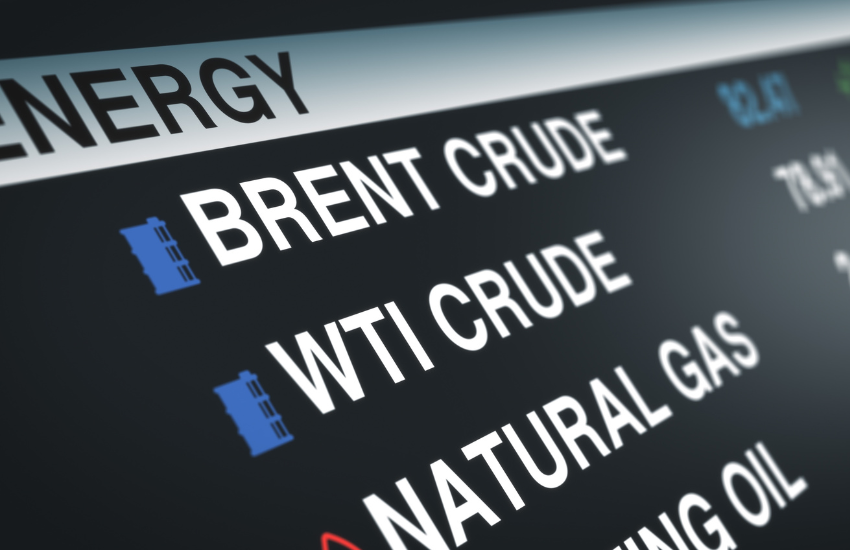
West Texas Intermediate (WTI) crude oil extended its gains for a second consecutive session, climbing close to $80 per barrel during Tuesday’s Asian trading hours, July 14. The benchmark reached its highest level in almost four weeks as rising geopolitical tensions fueled concerns over potential supply disruptions in the Middle East.
Crude oil prices strengthened after the United States launched a third consecutive night of military strikes against Iran, following President Donald Trump’s decision to reimpose a naval blockade on Iranian ports. Iran responded by targeting U.S. military facilities across the region, while two United Arab Emirates (UAE) oil tankers were reportedly struck by Iranian cruise missiles in the Strait of Hormuz.
The latest developments have intensified concerns over the security of one of the world’s most important energy shipping routes. Nearly 20% of global crude oil passes through the Strait of Hormuz, meaning any disruption could significantly tighten global supplies. As a result, traders quickly added a geopolitical risk premium to oil prices, extending WTI’s rebound from its lowest level since late February.
WTI’s technical outlook also continues to improve. The recent rally pushed prices above both the 23.6% Fibonacci retracement of the April-to-July decline and the closely watched 200-day Exponential Moving Average (EMA), a move widely viewed as a bullish breakout.
Momentum indicators also favor further gains. The Moving Average Convergence Divergence (MACD) has crossed firmly above the zero line, signaling strengthening buying momentum, while the Relative Strength Index (RSI) has risen to 55.10, indicating healthy bullish momentum without suggesting overbought conditions. Together, these indicators suggest buyers remain in control and that the current rally may still have room to extend.
Resistance and Support Levels to Watch
If bullish momentum continues, WTI could face its next resistance near $82.20, which marks the 38.2% Fibonacci retracement level. A sustained move above that area could open the door for additional gains toward $86.88, representing the 50% Fibonacci retracement, followed by $91.55, the 61.8% retracement level, where stronger selling pressure may emerge.
On the downside, immediate support is located around the 200-day EMA at $77.24, followed by the 23.6% Fibonacci retracement at $76.41. Should prices break below both levels, the next major support is seen near $67.06.
Despite the positive momentum, traders may remain cautious ahead of the release of the latest U.S. Consumer Price Index (CPI) data and testimony from Federal Reserve Chair Kevin Warsh. Both events could influence expectations for future interest rate policy, affect the U.S. dollar, and shape the next move in crude oil prices.
For now, WTI remains on a bullish path as geopolitical uncertainty continues to support supply concerns. However, upcoming U.S. economic data and signals from the Federal Reserve will likely determine whether the benchmark can maintain its position above the key $80 per barrel level or experience a short-term pullback.