



GBP/USD edged higher to around 1.3238 on Tuesday, October 13, as the pair attempted to stabilize following a sharp decline from the 1.3550–1.3560 region. Although buyers are defending the 1.3200 psychological level, the broader technical structure remains bearish. Improving short-term momentum offers some relief, but the pair needs to break above nearby resistance to strengthen its recovery prospects.
The British Pound received support from better-than-expected British Retail Consortium (BRC) Like-for-Like Retail Sales data. Comments from Bank of England (BoE) policymaker Megan Greene also attracted attention after she warned about the risk of persistent inflation if policymakers fail to act promptly.
Meanwhile, the US Dollar retreated from a recent 18-month high as investors took profits. This pullback helped GBP/USD recover from lower levels. However, the Pound’s gains remain vulnerable to renewed Dollar demand, particularly if incoming US economic data reinforces expectations of tighter monetary policy.
The US Dollar continues to face competing forces. Expectations of a potential Federal Reserve rate hike before the end of the year, together with persistent energy-driven inflation risks, could keep US Treasury yields elevated and limit further Dollar weakness.
Geopolitical tensions involving the United States and Iran, alongside conflict involving Iran-backed Houthi forces and the Saudi-led coalition in Yemen, may also support demand for safe-haven assets. These risks could restrict GBP/USD’s upside, even if the Dollar experiences further short-term profit-taking.
Technical Analysis
On the daily chart, GBP/USD consolidates around 1.3238 following a sharp sell-off, with the broader bearish structure still intact. Immediate resistance lies at 1.3284–1.3288, near the 78.6% Fibonacci retracement level. A sustained break above this zone could open the way toward 1.3351–1.3371 and 1.3429, while support at 1.3182 remains critical. A daily close below this support would strengthen the bearish outlook and expose the pair to further losses.
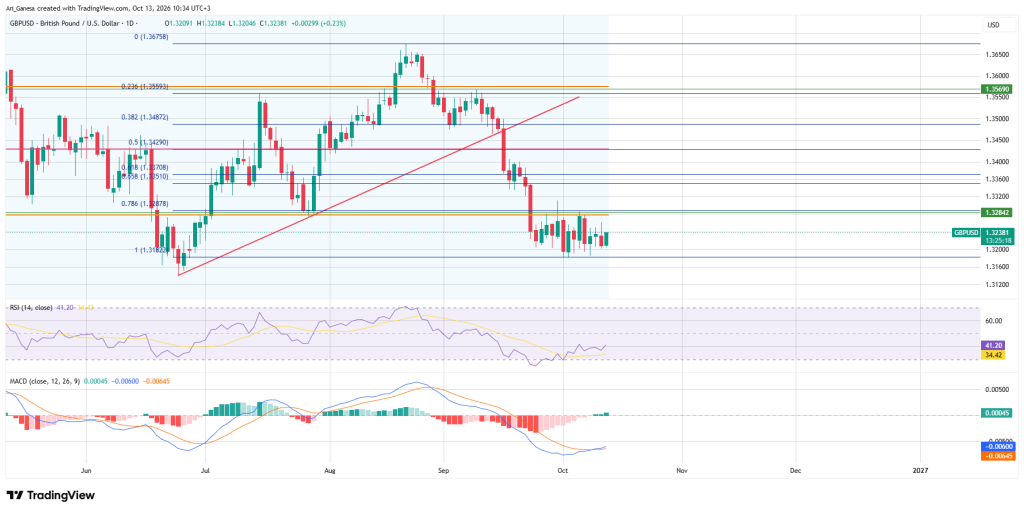
Momentum indicators suggest selling pressure is easing but has not reversed. The RSI stands at 41.20, below the neutral 50 level, while the MACD histogram has turned slightly positive even though both MACD lines remain below zero. This signals a potential short-term stabilization rather than a confirmed bullish reversal.
GBP/USD is therefore likely to remain under pressure unless buyers reclaim resistance at 1.3288. Traders should watch for a confirmed breakout or breakdown, alongside UK economic data, Federal Reserve policy expectations, US Treasury yields, and geopolitical developments. These factors could determine the pair’s next move and help traders identify potential opportunities while managing breakout risks.