



Poland’s economy continued to outperform much of the European Union in early 2026, with GDP expanding by around 3.5% despite easing from the 4.1% growth recorded at the end of 2025. The pace remains comfortably above the EU average, supported by resilient private consumption, EU funded investment, and elevated defence spending. Poland continues to allocate roughly 4% of GDP to defence, the highest share among NATO members, providing an additional pillar of economic support for the złoty (PLN).
The National Bank of Poland (NBP) has kept its reference rate at 3.75% through mid 2026, the lowest level since 2022, following a series of rate cuts that brought inflation back close to the central bank’s 2.5% target after the post 2022 energy price shock. The labour market remains tight, with unemployment near historic lows at around 5%, while wage growth continues to outpace inflation despite slowing to approximately 5% to 6% year on year. These fundamentals continue to support the złoty, although above target inflation risks and a widening fiscal deficit, projected at around 6.5% of GDP in 2026, remain key factors for traders.
Poland’s trade profile is heavily concentrated on the euro area, making EURPLN the most relevant currency pair for assessing the złoty’s long term outlook. The European Union accounts for nearly 79% of Polish exports and around 64% of imports, with Germany representing the largest trading partner on both sides. This close integration links Poland’s industrial performance and currency closely to eurozone demand.
As a result, EURPLN has generally traded with relatively low volatility compared with other Central and Eastern European currency pairs. The pair has been supported by the NBP’s preference for a stable currency and steady inflows from EU structural and recovery funds. Interest rate differentials also remain an important driver. With Poland’s policy rate still above that of the European Central Bank, EURPLN has periodically faced downward pressure from carry flows. However, this has been partly offset by Poland’s shift into a goods trade deficit of around €6 billion in 2025 as imports have outpaced exports.
Technical Analysis
The weekly chart highlights the złoty’s sustained appreciation from 2022 onward, reflected by a decline in EURPLN. This period coincided with broad euro weakness against the US dollar, with EURUSD trading near or below parity. The strongest move occurred during 2023, when EURPLN fell from approximately 4.90 to almost 4.35 in less than six months.
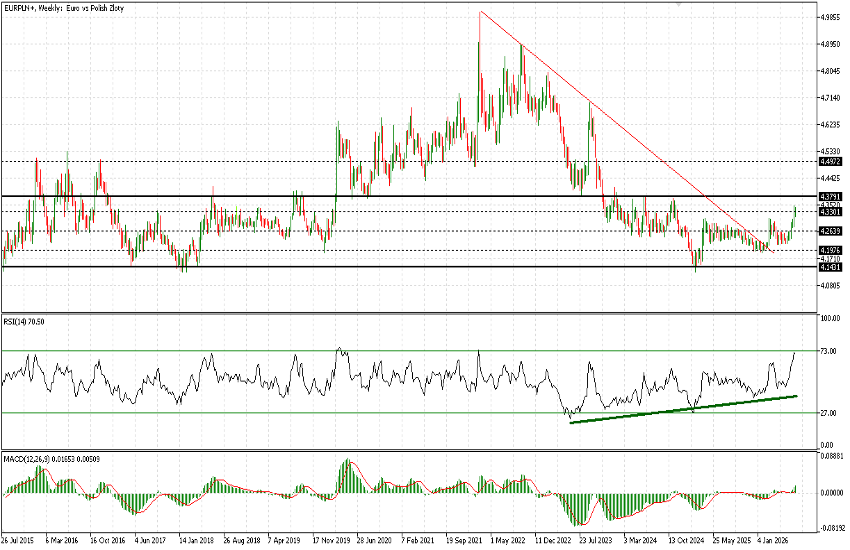
Since 2024, however, the downtrend has gradually lost momentum. During 2026, EURPLN has formed two notable bullish advances, suggesting the market may be establishing the foundation for a more constructive outlook. This shift aligns with Poland’s transition into a trade deficit beginning in the second quarter of 2024. While trade balance changes can initially appear temporary, they often become more significant when viewed over a longer period.
The 4.14 level remains a critical technical zone, serving as major support and resistance since at least 2014 and extending back to the early 2000s. EURPLN tested this level in February last year, where it marked the end of the long term bearish trend. As a result, the 4.14 to 4.90 range continues to define the pair’s broader trading structure.
Momentum indicators also support a bullish outlook. A weekly RSI bullish divergence developed nearly a year before EURPLN reached its low, while the weekly MACD has recently crossed above the zero line, reinforcing the potential for further gains.
The first upside objective is located at 4.38, which offers a more precise target than the broader 4.35 resistance area. A decisive break above 4.38 would strengthen the bullish case and expose the next major resistance near 4.50.
Additional confirmation comes from the long term descending trendline, which was broken late last year. Combined with improving momentum signals, this continues to support a constructive outlook for EURPLN. At the time of writing, the exchange rate stands at 4.3240.