



The USDA’s June 2026 World Agricultural Supply and Demand Estimates (WASDE) report offered little support for grain markets. Corn futures fell to fresh contract lows after the report delivered few surprises and left traders facing the same fundamental reality: abundant supply continues to outweigh inflationary pressures.
The broader picture is particularly notable. Agricultural commodities, including corn, wheat, soybeans, cotton, and coffee, have trended lower even as inflation has accelerated across the wider economy. This divergence challenges the conventional assumption that rising consumer prices should automatically support food and agricultural markets.
For corn, the explanation remains largely supply-driven. The USDA projects 2026/27 global beginning stocks above 303 million metric tons and production exceeding 1.3 billion metric tons, both revised higher from May estimates. The combination points to a market where plentiful supply continues to dominate pricing dynamics.
Corn has been among the weakest performers. The July contract reached its highest closing price of 2026 on May 4 at $4.85¾ per bushel. Since then, favorable weather conditions and strong planting progress have triggered sustained selling pressure, pushing prices to four-month lows near $4.32 per bushel.
U.S. planting progress reached approximately 93% by late May, well ahead of the five-year average. Crop emergence also exceeded seasonal norms at 76%, indicating a crop that is both early and broadly established.
Warm temperatures during early June are expected to accelerate crop development further, while additional rainfall across the western Corn Belt has improved soil moisture conditions and reinforced expectations for strong yields. Currently, 67% of the corn crop across major producing states is rated good-to-excellent.
On the demand side, the WASDE report provided little support. The USDA left its projection for new-crop corn ending stocks unchanged at 1.96 billion bushels and maintained its season-average farm price forecast at $4.40 per bushel. Meanwhile, estimates for 2025/26 corn use in ethanol production were revised lower.
With weather conditions remaining favourable, planting ahead of schedule, and the USDA maintaining optimistic supply projections, downward pressure on corn prices may persist through the summer unless adverse weather conditions materially alter production expectations.
Technical Analysis
Corn—which is quoted on our platform in U.S. cents—broke below the uptrend line that had supported prices since August 2025 on May 29 at 467 cents. What followed was a swift decline to yesterday’s low of 431.95 cents.
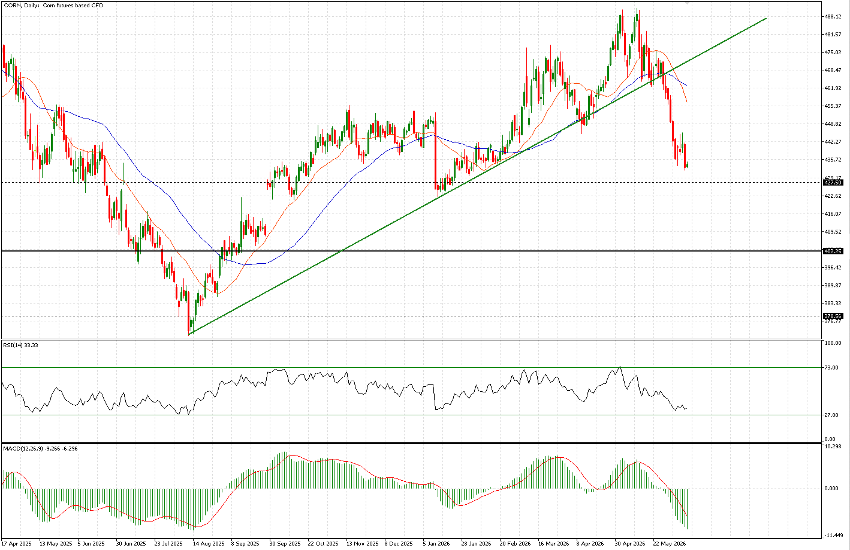
This area could act as a temporary support zone, roughly between 423 and 433 cents, representing a range of approximately 2.5%. Within this zone, it is reasonable to expect some profit-taking from short sellers and attempts by buyers to accumulate at what may be perceived as attractive prices, particularly considering that, as mentioned above, the USDA’s season-average price forecast stands at around 440 cents.
That said, we believe there is a realistic possibility of another leg lower. The next major support area lies somewhat further down, between 400 and 408 cents. Technical indicators continue to weaken but have not yet reached oversold territory. Meanwhile, the 21-day and 50-day moving averages have recently completed a bearish crossover.
In summary, we believe the current decline may experience a temporary slowdown or pause not far from current levels before resuming its downward trajectory in the coming weeks, potentially targeting the lower support zone.