



The Gator Oscillator was created by American trader and theorist Bill Williams, introduced alongside the Alligator indicator in his 1995 book Trading Chaos. Williams believed markets spend most of their time in a “sleeping,” non-trending state, and his goal was to identify precisely when they awaken into directional moves.
The Alligator uses three smoothed moving averages — the Jaw (13-period SMMA, offset 8 bars), Teeth (8-period, offset 5), and Lips (5-period, offset 3). The Gator is not a separate tool: it is a histogram representation of the distance between these three lines, translating their convergence and divergence into a clear visual phase reading. Direction comes from the Alligator; intensity comes from the Gator.
How the Gator Oscillator Works
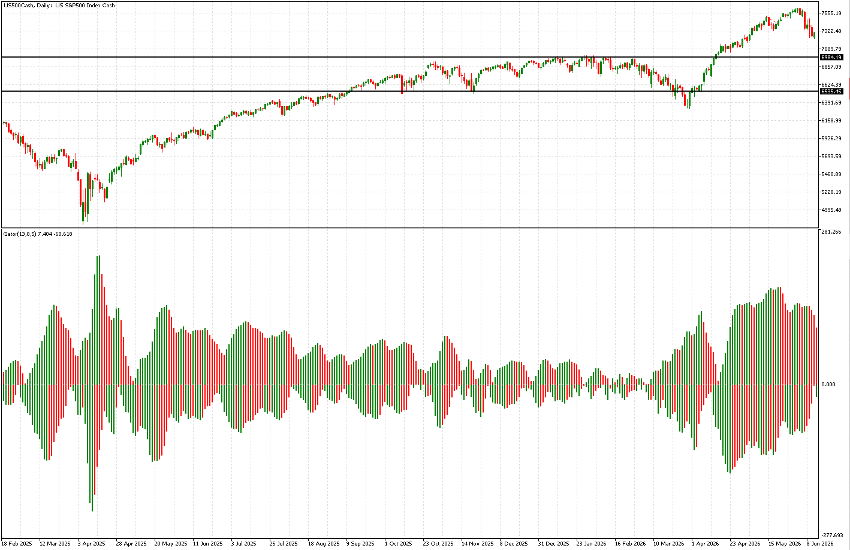
The Gator plots two histograms around a zero line:
- Upper histogram (positive): absolute difference between Jaw and Teeth — |Jaw − Teeth|
- Lower histogram (negative): absolute difference between Teeth and Lips, plotted below zero — −|Teeth − Lips|
Each bar is coloured green if larger than the previous (expanding energy) or red if smaller (contracting). This produces four named phases:
- Sleeping: both histograms red — market consolidating.
- Awakening: one green, one red — energy returning.
- Eating: both green — trend in full force.
- ▸ Sated: one red, one green — momentum fading.
Why Traders Use the Gator Oscillator
The Gator Oscillator helps traders identify when markets transition from consolidation into trend. Rather than focusing on price direction, it measures the expansion and contraction of the Alligator’s moving averages, providing insight into trend development and market participation.
Its primary purpose is to help traders avoid low-activity environments and identify periods when momentum is beginning to build. Used alongside the Alligator indicator, it can also help traders stay in strong trends while avoiding premature exits.
Understanding the Four Phases
| Phase | Meaning | Typical Trader Response |
| Sleeping | Market consolidating | Wait for confirmation |
| Awakening | Trend may be emerging | Prepare for a breakout |
| Eating | Trend gaining strength | Hold or add to positions |
| Sated | Trend losing momentum | Reduce exposure or monitor for reversal |
Strengths and Weaknesses
Strengths
The Gator’s greatest virtue is phase clarity. It removes the ambiguity of reading three overlapping moving average lines and delivers an objective, colour-coded state of market energy. It does not repaint, making it reliable for backtesting. Its real edge lies in detecting transitions — particularly the shift from Sleep to Awakening that precedes breakouts.
Weaknesses
As a moving-average derivative, the Gator lags price. It confirms phase changes after they begin, not before. It also carries no directional bias — a trader must pair it with the Alligator or another trend tool to know whether the market is eating upward or downward. In news-driven, choppy conditions, rapid colour alternations can produce misleading signals.
The Gator is a volatility phase detector, not a directional signal. Always establish trend direction separately before using the Gator as a trigger.
Best Markets and Timeframes
The Gator Oscillator performs best in markets that exhibit clear trending behaviour, including major forex pairs, equity indices, commodities, and large-cap stocks.
Although it can be applied to any timeframe, signals on higher timeframes tend to be more reliable because they are less affected by short-term market noise. Lower timeframes may generate more frequent phase changes and false signals, particularly during periods of low liquidity.
Trending vs Lateral Markets
The Gator Oscillator behaves differently depending on market conditions, making context essential when interpreting its signals.
In trending markets, the most important phase is Eating, when both histograms are expanding and coloured green. This confirms that the trend remains active and that momentum is still supporting the move. Rather than serving as a fresh entry signal, the Eating phase is often more useful for managing existing positions or identifying opportunities to add during pullbacks.
In sideways or range-bound markets, the Gator becomes particularly valuable as an early warning tool. A transition from Sleeping to Awakening suggests that market participation is increasing and that a breakout may be approaching. Conversely, the Sated phase often signals that momentum is fading and that traders should begin monitoring for exhaustion or reversal conditions.
Core Trading Strategies
Strategy 1 · The Alligator Awakening Breakout
This is one of the highest-conviction Gator setups because it combines market compression, a phase transition, and directional confirmation.
Setup
- The Gator moves from Sleeping to Awakening.
- The Alligator lines are tightly compressed.
- Price has been consolidating within a well-defined range.
Entry
- Enter on a confirmed breakout above resistance or below support.
- Look for a second green histogram bar to confirm expanding participation.
Confirmation
- The Alligator’s Lips cross in the direction of the breakout.
Stop
- Inside the consolidation range.
Strategy 2 · Trend Continuation During the Eating Phase
This approach focuses on joining an existing trend rather than attempting to predict a new one.
Setup
- Both Gator histograms remain green.
- Price pulls back toward the Alligator’s Teeth or Jaw.
- The trend structure remains intact.
Entry
- Enter following a bullish or bearish engulfing candle near support or resistance created by the Alligator.
Confirmation
- RSI remains above 50 in bullish trends or below 50 in bearish trends.
Stop
- Beyond the Jaw line.
This strategy uses the Gator to confirm that momentum remains present during temporary retracements.
Strategy 3 · Sated Phase Exit and Reversal Watch
The Sated phase can provide valuable information about trend exhaustion.
Setup
- One histogram turns red after a prolonged trend.
- Price reaches a major technical level such as prior resistance or a Fibonacci extension.
Trade Management
- Consider reducing exposure or taking profits on existing positions.
Potential Reversal
- Wait for the market to return to Sleeping mode and for a clear reversal pattern to emerge before considering a counter-trend position.
The objective is not to predict reversals but to recognise when the conditions supporting the existing trend are beginning to weaken.
Advanced Applications
Gator Divergence with MACD
Occasionally, price will make a new high while the Gator fails to show a corresponding expansion in participation. When this occurs alongside a similar divergence in the MACD histogram, it may signal that trend momentum is weakening.
Because divergence can persist for extended periods before resolving, this setup is best used as an early warning signal rather than a standalone entry trigger.
Failed Awakening in a Range
In range-bound markets, the Gator may briefly enter the Awakening phase only to return quickly to Sleep. When this occurs alongside a failed breakout attempt, it can provide opportunities to trade back toward the centre or opposite side of the range.
This is generally considered a lower-conviction setup and should be approached with reduced position sizing and strong risk management.
Conclusion
The Gator Oscillator rewards traders who understand what it is actually measuring. Unlike traditional momentum indicators, it does not focus on price direction. Instead, it tracks the expansion and contraction of trend structure through the relationship between the Alligator’s moving averages.
Used on its own, the Gator provides useful insight into market phases. Used alongside the Alligator, candlestick analysis, and complementary indicators such as the RSI or MACD, it becomes a powerful tool for identifying when markets are preparing to move, actively trending, or beginning to lose momentum.
Its greatest value lies in helping traders avoid low-probability conditions while remaining focused on periods when participation, volatility, and trend development are working together.