



Rising geopolitical tensions in the Middle East have pushed Brent crude to a critical technical and macroeconomic juncture. With supply risks intensifying around two of the world’s most important maritime chokepoints, oil markets are once again confronting the possibility of prolonged disruption.
Markets spent last Friday digesting a Reuters report that Iran has instructed the Houthis to prepare to close the Bab el-Mandeb Strait if the United States strikes Iranian power infrastructure. Missiles and drones are reportedly already positioned near the waterway, awaiting orders from IRGC officers in Yemen.
The threat escalated over the weekend after the Houthis declared a maritime embargo against Saudi Arabia, accusing Riyadh of bombing Sanaa Airport. The development is significant because Saudi Arabia has been redirecting substantial crude exports via pipeline to a Red Sea terminal to offset the closure of the Strait of Hormuz. Any disruption at Bab el-Mandeb would effectively shut down that alternative export route.
This is the same chokepoint targeted by the Houthis during 2023 and 2024, when Red Sea shipping traffic was reduced by roughly half, forcing vessels to reroute around the Cape of Good Hope. Although a late-2025 ceasefire restored much of the traffic flow, Bab el-Mandeb has become even more strategically important since the closure of Hormuz earlier this year, serving as one of the few remaining export routes for Gulf crude heading to Europe and Asia.
According to EIA data, crude oil and petroleum liquids passing through Bab el-Mandeb fell from more than 9 million barrels per day in 2023 to around 4 million barrels per day during 2024 and 2025 following the first Houthi campaign. Flows have since recovered to approximately 5.4 million barrels per day in the first quarter of 2026 as exports were rerouted away from Hormuz.
LNG shipments have also rebounded to around 2.9 billion cubic feet per day after previously dropping to zero. Even so, Bab el-Mandeb still facilitates nearly 12% of global seaborne oil trade. While that is smaller than Hormuz’s typical throughput of roughly 20 million barrels per day, the market would struggle to absorb another major supply disruption while Hormuz remains effectively closed.
The brief reopening of the Strait of Hormuz under June’s Islamabad Memorandum has now reversed. After the ceasefire collapsed around July 7, Iran resumed attacks on tankers, and the IRGC officially re-declared the strait closed on July 19.
The latest PortWatch data from July 12 showed only 10 vessel transits, compared with the pre-crisis average of around 88 per day, while roughly 490 vessels remain anchored nearby.
The production impact is becoming increasingly significant. Kuwait has reportedly been forced to cut production by approximately 2.8 million barrels per day after storage facilities reached capacity with exports blocked. JPMorgan estimates total Gulf production shut-ins could approach 5 million barrels per day if the closure persists, while some analysts warn that between 10% and 30% of idled production capacity could suffer permanent reservoir damage rather than recover immediately once exports resume.
Brent Technical Analysis
Approximately two weeks ago, in our July 8 Brent analysis, we highlighted further upside potential after Brent returned to trade near $76 per barrel. We identified upside targets at $81.20, $82.60, and finally $87.50.
Brent is now trading around $87.05 after reaching an intraday high of $88.99 yesterday, meaning all previously identified upside targets have now been achieved.
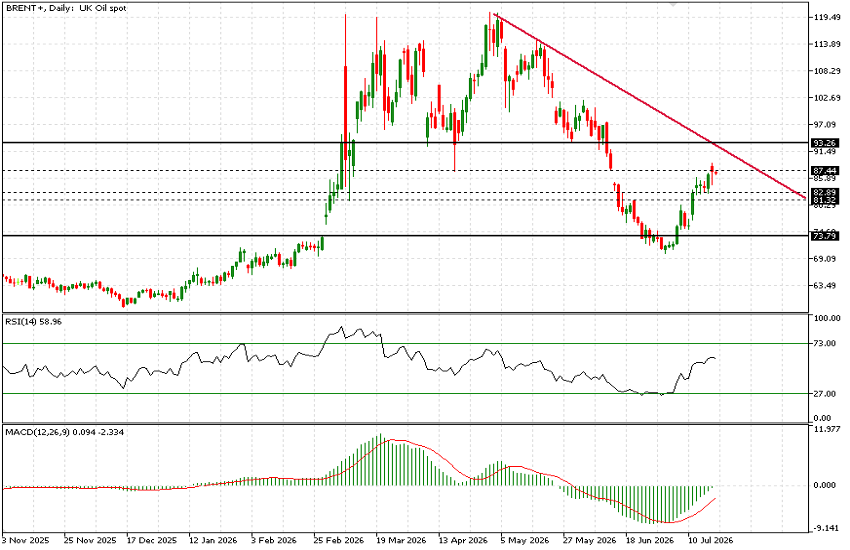
Looking purely at the technical picture, Brent may still have room to extend higher after its sharp rally. The next key resistance comes from the descending daily trendline, currently located near $92.30.
Trendlines should not be viewed as precise price targets, but rather as technical reference areas. Nevertheless, this level deserves close attention given its confluence with historical price action.
A move toward that area would also bring Brent close to the $93.00 to $93.25 zone, which acted as major support between March and early June. A sustained recovery above this range would represent a significant technical development and would also carry important macroeconomic consequences.
Higher oil prices would increase inflationary pressures at a time when strategic petroleum reserves are already significantly depleted. The US Strategic Petroleum Reserve has fallen to its lowest level since 1984 after declining by roughly half over the past five years. Further increases in crude prices could also weigh on broader financial markets by increasing costs across the global economy.