



The US Dollar Index (DXY) weakened to around 99.39 in early European trading on Thursday, September 3, as US Treasury yields eased from recent multi-year highs. The dollar came under pressure after fresh data showed private-sector hiring slowed in August, increasing market focus on Friday’s official US employment report.
The ADP National Employment Report showed that US private employers added 38,000 jobs in August, down from a revised 46,000 in July and below market expectations of roughly 47,000–48,000. It was the weakest pace of private-sector job creation since January. Education and health services led hiring with 45,000 jobs, while manufacturing lost 17,000 positions and professional and business services shed 16,000.
The weaker hiring figure has added to concerns that the US labor market is losing momentum. At the same time, markets are closely watching Federal Reserve policy because inflation remains above the central bank’s 2% target. Fed Chair Kevin Warsh said at Jackson Hole that price stability remains a firm 2% objective and stressed that policymakers need to focus on underlying inflation trends while also recognizing that the labor market remains broadly stable.
Attention now shifts to the August US Employment Situation report, scheduled for Friday, September 4 at 8:30 a.m. ET. Current forecasts call for a modest increase of around 53,000 nonfarm payrolls, while the unemployment rate is expected to remain at 4.1%. The official report will provide a broader view of the labor market than the ADP private-sector survey.
Technical Analysis
Based on the daily DXY chart, the index is trading around 99.39, just above the 61.8% Fibonacci retracement at 99.22. This level is the first important support after the recent rebound from the 98.52 area, which corresponds to the 78.6% Fibonacci retracement.
The recovery has so far failed to overcome the 99.70–99.71 zone, marked by the 50% Fibonacci retracement. A daily close above this resistance would strengthen the bullish recovery and could open the way toward 100.20, followed by 100.82. Above that, the psychological 101.00 area and the previous swing high around 101.80 become the next potential upside targets.
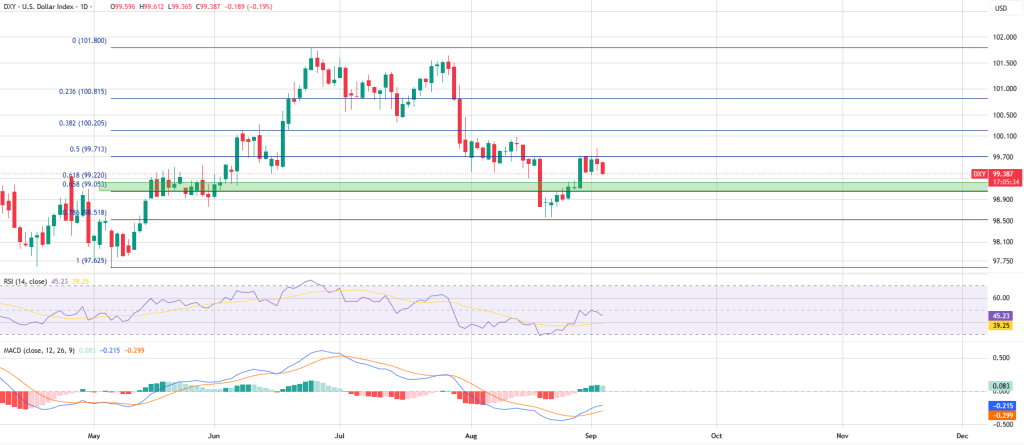
Momentum remains mixed. The RSI stands at 45.23, below the neutral 50 threshold, indicating that bullish momentum has yet to take control. However, the indicator has recovered from lower levels. The MACD has also turned more constructive, with the MACD line at around -0.215 above the signal line near -0.299, while the histogram has moved into positive territory. This points to improving short-term momentum, although a break above 99.70–99.71 would provide stronger confirmation.
On the downside, 99.22 is the key initial support. A decisive break below it would increase the risk of a move toward 99.05, followed by 98.52. Losing 98.52 would weaken the recent rebound structure and expose the 97.63 area as the next major downside level.
For traders, the combination of weakening private-sector employment, easing Treasury yields and a still hawkish Fed backdrop creates a potentially volatile setup for DXY. Friday’s NFP report is particularly important because a stronger or weaker labor-market reading could quickly shift expectations for the Fed’s September decision, Treasury yields and the US dollar. Technically, 99.22 and 99.70–99.71 are the key levels to watch for the next directional move.