


Broadcom (AVGO) fell 12.78% on Thursday after opening down as much as 14.66%. The decline spread across the semiconductor sector, with AMD losing 4.52%, Micron falling 8.43%, and the iShares Semiconductor ETF (SOXX) declining 2.83%.
The move reflected a sharp round of profit-taking following a strong rally in semiconductor stocks over recent weeks. Not all names participated in the selloff. Cisco gained 3.01%, Marvell advanced 3.02%, and NVIDIA (NVDA) added 1.17%. Nevertheless, the reaction highlighted growing investor sensitivity toward technology companies that some market participants believe are trading at elevated valuations.
Broadcom reported Q2 FY2026 results that were broadly stronger than expected. Revenue reached $22.19 billion, slightly above the consensus estimate of $22.13 billion. Earnings per share came in at $2.44, beating expectations of $2.39. AI chip revenue more than doubled to $10.8 billion, while net income surged 88% to $9.31 billion.
The market’s concern centered on forward guidance. Management projected Q3 AI chip revenue of approximately $16 billion, below the market’s whisper expectation of $17.2 billion. More importantly, CEO Hock Tan reaffirmed the company’s existing target of $100 billion in AI-related revenue by fiscal 2027 rather than raising it.
The infrastructure software segment also contributed to investor disappointment. Revenue from the VMware-driven business reached $7.18 billion, below analyst expectations of $7.32 billion, although it still represented 9% year-on-year growth.
Despite the weakness in semiconductor stocks, the broader market remained resilient. The Nasdaq declined 0.52%, while the Dow Jones Industrial Average gained 1.73% and reached a fresh all-time high.
Technical Analysis
After closing at $478.85 and reaching a high of $489.85 in the previous session, AVGO opened nearly 15% lower. The chart provides a notable example of how technical levels can influence price action.
Both the opening price and the session low aligned closely with the lower boundary of the trading range where the stock had traded from mid-April until only a few days earlier. The intraday low at $403 coincided almost exactly with a previously established support zone.
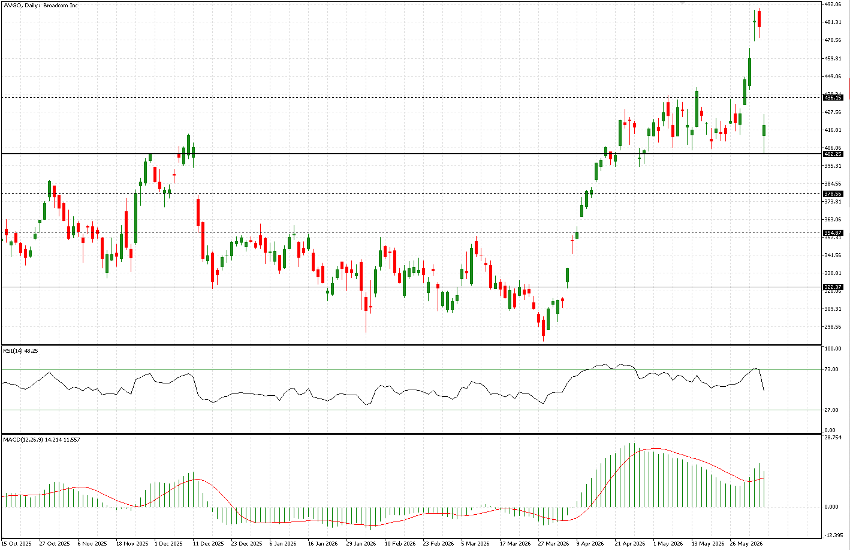
The stock recovered part of its losses during the session and closed near the middle of that trading range. The upper boundary remains around $435, and a test of that level from below would not be surprising in the near term. Technical indicators have also reset, with the Relative Strength Index (RSI) now standing at a neutral 48.25.
If broader market weakness develops, a retest of the $400 area remains possible, with further downside toward $378 also within range. However, caution is warranted before projecting significant additional weakness in one of the market’s strongest performers of recent years.
The broader investment case for artificial intelligence remains intact. AI technology continues to transform industries, improve productivity, and create new opportunities across the global economy. The challenge for investors is not necessarily the quality of the technology but the price being paid for exposure to it.
A world-class asset can still become a poor investment if purchased at an excessive valuation. Broadcom’s earnings report serves as a reminder that in markets driven by high expectations, strong results alone may not be enough. When valuations become stretched, even minor disappointments can trigger significant price reactions.