


The 7 May local elections delivered a major setback to Keir Starmer’s government, with Labour losing 1,121 councillors and control of 28 councils. Reform UK gained 1,257 seats and took control of 10 councils, while the Greens recorded historic gains, including victories across several London boroughs.
The political fallout was immediate. Around 30 Labour MPs publicly called for either a leadership change or a timeline for Starmer’s resignation, while Health Secretary Wes Streeting resigned from the Cabinet, stating he had “lost confidence” in Starmer’s leadership.
For financial markets, the focus is less on personalities and more on the implications for fiscal policy. A leadership transition would likely bring a new chancellor and potentially a more expansionary fiscal stance, including looser fiscal rules and higher borrowing. The next Autumn Budget is not expected until October or November, and for now the FY2025 deficit is still projected around 4.3%, below the Office for Budget Responsibility’s 4.5% estimate.
Meanwhile, the gilt market remains under pressure. UK 10-year yields moved above 5% for the first time since 2008, while the 30-year gilt yield reached its highest level since 1998.
The rise in yields reflects a combination of Labour’s spending ambitions, sticky inflation, and supply pressures linked to the Bank of England’s quantitative tightening programme, currently running near £100 billion annually.
Comparisons with the September 2022 Liz Truss mini-budget have resurfaced, although important differences remain. Foreign demand for gilts continues to hold relatively firm and, unlike 2022, the current move in yields has developed gradually rather than through a sudden liquidity shock. The latest selloff also appears more globally driven, with rising yields across major economies and higher energy prices acting as the primary catalyst rather than a direct loss of confidence in UK fiscal credibility.
Underlying UK growth remains weak. GDP continues to run below Bank of England estimates, while unemployment rose to 4.9% during the December 2025 to February 2026 period and is projected to increase further toward 5.1% in Q2 2026.
This morning’s drop in year-on-year inflation to 2.8% was, however, a significant positive surprise for the central bank.
Even so, market expectations for monetary policy are shifting toward a shorter and more cautious easing cycle. Some previously expected rate cuts are no longer fully priced in, while a minority of market participants have even started discussing the possibility of further tightening.
Ultimately, the outlook will depend on whether the recent energy-price shock proves temporary and how much political uncertainty emerges ahead of the Autumn Budget season.
Technical Analysis
Despite the rise in gilt yields and political uncertainty, sterling and GBPUSD continue to trade largely sideways, maintaining the broad range that has defined price action since April 2025.
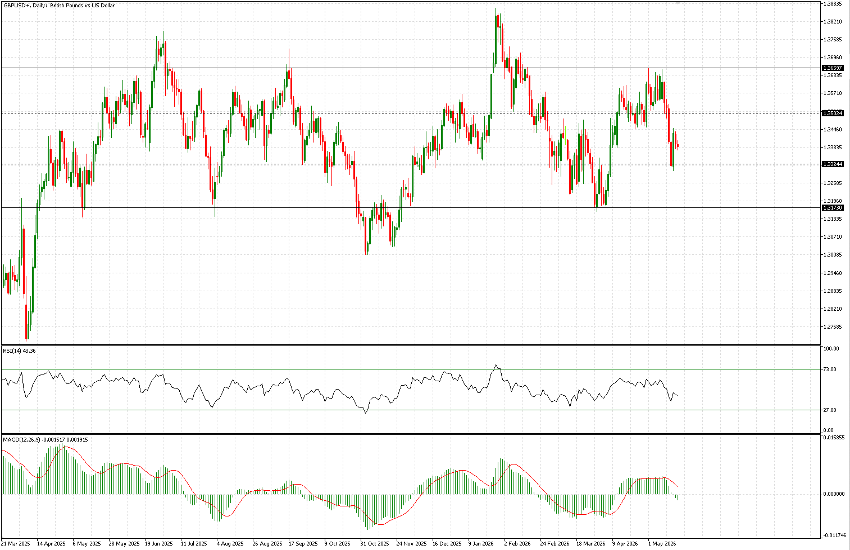
The pair continues to fluctuate within a broad 1.3150–1.3650 range, where the market appears to have found temporary equilibrium.
Within this structure, two additional levels stand out: 1.3325 and 1.3500. Both have played a significant role in recent price action, with sterling weakening from a test of the 1.3650 area toward the current level near 1.3382.
The 1.3500 zone acted as support throughout April before eventually breaking, accelerating the move lower toward 1.3325 within two sessions. A modest rebound has followed this week, potentially supported by softer-than-expected inflation data.
Despite higher long-end yields, the broader technical structure still suggests downside risks for GBPUSD toward the area below 1.3200 in the coming sessions, although much will continue to depend on USD direction and broader risk sentiment.
The broader picture remains similar against the euro, where EURGBP has also traded within a prolonged range, roughly between 0.8600 and 0.8750 in recent months.