



President Trump returned last week from a two-day trade summit in Beijing with President Xi Jinping, highlighting what he described as a landmark agricultural agreement. The White House announced that China agreed to purchase at least $17 billion of U.S. agricultural products annually through 2028.
Soybeans remain central to the deal. Trump stated that China committed to purchasing 12 million metric tons in the current marketing year and 25 million metric tons annually over the following three years.
The scale of the agreement reflects a sharp reversal in trade flows. China’s imports of U.S. agricultural goods peaked at $38 billion in 2022 but declined to just $8 billion in 2025. Soybean purchases dropped even more significantly, from nearly $18 billion to $3 billion, after Beijing halted buying during the height of the tariff dispute.
The global soybean market is concentrated among a small group of major players. On the supply side, the United States, Brazil, and Argentina account for the majority of global production. Brazil has overtaken the U.S. as the largest exporter over the past decade, marking a structural shift in pricing dynamics. While the U.S. Midwest remains one of the most efficient production regions globally, American farmers now compete with South American harvest cycles that enable near year-round supply.
On the demand side, China dominates global trade, historically accounting for 60% to 65% of soybean imports. Demand is primarily driven by its large livestock sector, particularly hog and poultry production, as well as a growing biofuel industry.
Soybean prices are influenced by multiple factors. Weather patterns, particularly El Niño and La Niña cycles affecting South American yields, remain critical. Energy prices also play a role by shaping biofuel demand. Currency movements, especially the U.S. dollar, impact export competitiveness.
Market participants also closely monitor the crush spread, which reflects the margin between raw soybeans and processed products such as soybean oil and meal. Geopolitical developments, including U.S.–China trade relations, continue to remain a major market driver.
The global supply and demand balance is tracked through the USDA’s monthly WASDE report. With Chinese demand suppressed for more than a year and now potentially returning at scale, the market may be approaching an important inflection point. However, the gap between political commitments and actual shipment volumes will remain critical for future price direction.
Technical Analysis
China’s withdrawal from the U.S. market is clearly reflected in soybean price action. Soybean futures declined steadily after peaking in June 2021 at 1,785 cents per bushel.
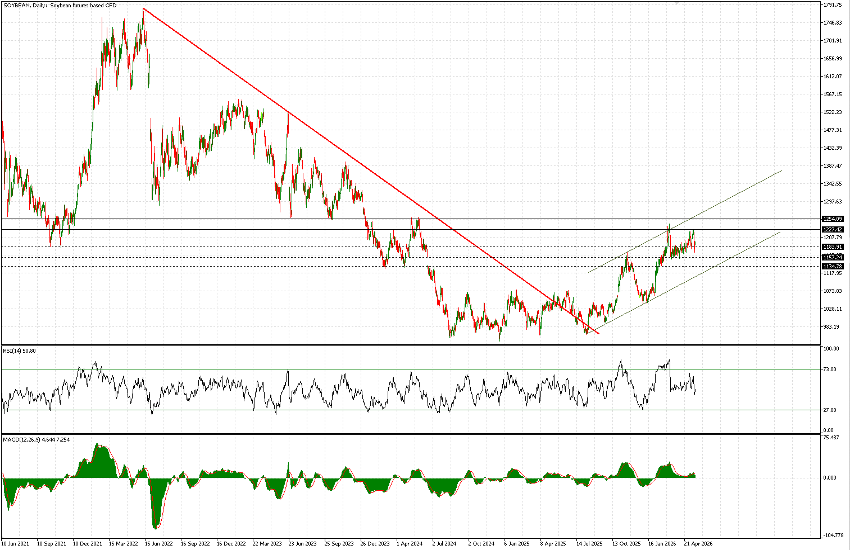
The market reached a low in August 2024 around 956 cents. This level was tested multiple times over the following year, forming a strong support zone. After the most recent test in August 2025, prices broke above the long-term bearish trendline, signalling a shift in momentum.
Prices then moved toward the upper boundary of the trading range near 1,075 cents and successfully broke above it. This breakout established the foundation for a bullish trend that has continued, with prices recently reaching approximately 1,195 cents.
Price action is now consolidating within an upward channel after testing the upper boundary. Notably, this consolidation follows repeated tests of a key resistance zone between 1,225 and 1,255 cents, a level that has held since 2023.
From the current level near 1,185 cents, key support zones to monitor are 1,157 and 1,134 cents, which previously acted as important levels between February and July 2024. These areas may present potential entry points, particularly as recent geopolitical developments support a constructive market outlook.
Overall, the technical structure continues to support the possibility of a retest of the 1,255-cent resistance zone, with scope for further upside should bullish momentum remain intact.