



Artificial intelligence continues to reshape global equity markets, with semiconductor demand becoming one of the strongest drivers of earnings growth across the technology sector. As AI infrastructure investment accelerates, companies positioned within the memory and data-processing ecosystem are seeing unprecedented demand, rapidly transforming both revenue expectations and market valuations.
As RBC’s Head of US Equity Strategy, Lori Calvasina, recently noted: “I think maybe people in the geopolitical world do not fully understand what is happening with AI trade and earnings, and how much of a buffer that is for S&P 500 EPS.”
Demand and capital expenditure across the AI supply chain remain exceptionally strong. The market continues to face capacity constraints and bottlenecks, while companies with critical technologies are struggling to keep pace with accelerating client demand.
The latest earnings season further reinforced this trend. AMD reported strong results and surged 14% in after-hours trading. In Asia, Samsung gained 15%, entering the $1 trillion market-capitalisation club for the first time, while SK Hynix advanced 10%, helping push South Korea’s Kospi index above 7,000 for the first time.
Samsung and SK Hynix are particularly relevant because of their close relationship to the High Bandwidth Memory (HBM) market, where they compete directly with Micron. HBM technology has become essential for AI workloads, allowing GPUs to process and transfer massive volumes of data more efficiently than traditional memory systems.
Unlike standard memory chips, HBM stacks memory vertically and places it closer to the GPU, significantly reducing latency and improving performance. In practical terms, this functions as ultra-high-capacity memory integrated directly into AI processors. NVIDIA’s Blackwell platform, for example, approaches 300GB of integrated memory capacity, while the latest HBM4 generation is capable of transmitting nearly 3 terabytes of data per second.
Micron remains a challenger in this segment, with market share still below 15%, but the company is gaining ground rapidly. Its memory chips are now integrated into NVIDIA’s latest GPU platforms, while HBM4 samples are already being tested by customers.
The company recently reported record quarterly revenue of $13.64 billion, up 57% year-on-year, with gross margins exceeding 56%—levels historically uncommon for memory chip manufacturers. Analysts currently project revenue growth of approximately 89% and earnings-per-share growth of around 278% for fiscal 2026.
Despite this, Micron still trades at a relatively modest forward price-to-earnings ratio, suggesting that markets may not yet fully reflect its transition from a cyclical memory producer into a strategic AI infrastructure supplier.
TECHNICAL ANALYSIS
From a technical perspective, MU gained a further 11.06% yesterday and now trades near $640.20. Momentum indicators remain positive but increasingly overbought. Price action is significantly extended above key moving averages and continues to trade well beyond the upper Bollinger Band.
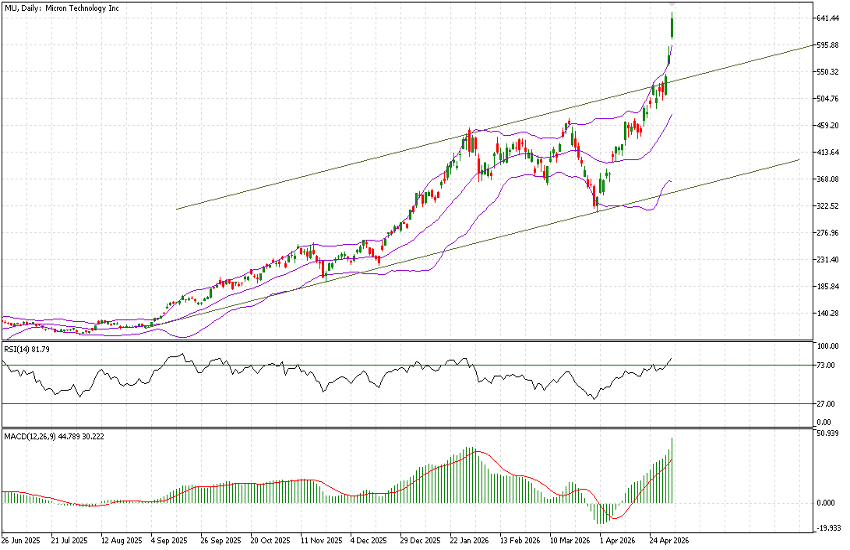
MU Daily Jul 2025 to Now
The stock has also broken decisively above its previous trading channel, with the last three sessions reflecting strong acceleration in momentum. Importantly, this move is unfolding during earnings season, potentially signalling a broader re-rating by both analysts and institutional investors.
While entering new long positions at current levels carries elevated short-term risk, the stock remains one of the most important names to monitor within the AI infrastructure theme. Momentum remains exceptionally strong, and the longer-term upside potential may still not be fully reflected in current valuations.