



USDCHF was trading around 0.8088 at the time of writing, easing from the one-year high near 0.8139 reached on June 24 as US dollar demand moderated. Even so, the Swiss franc remains roughly 6.3% weaker against the dollar compared with the lows recorded in January 2026.
Despite this year’s weakness, the franc remains one of the world’s strongest currencies. At its June meeting, the Swiss National Bank held its policy rate at 0% for a fourth consecutive meeting, while inflation rose only modestly from 0.1% in February to 0.6% in May, remaining firmly within the SNB’s 0% to 2% comfort zone.
This combination of a structurally strong currency and near-zero rates is notable because it challenges what textbook interest rate parity would typically suggest. The franc does not hold its value because of yield. Instead, it is supported by Switzerland’s political stability, current account surpluses, deep capital markets, and its role as a preferred destination for capital during periods of global risk aversion.
Low rates are possible precisely because the franc’s structural strength already performs much of the disinflationary work. A firm currency helps contain imported prices, which account for around 22% of the CPI basket, even when energy costs rise.
Switzerland’s foreign exchange policy differs significantly from Japan’s. The Bank of Japan has spent years responding to yen weakness, including intervention to support the currency as ultra-low rates and capital outflows weighed on the exchange rate.
The SNB faces the opposite challenge. Its low-rate environment coexists with a structurally strong currency that can appreciate too rapidly during periods of heightened global risk aversion. This can be disinflationary, or even deflationary, for Switzerland while also pressuring the export sector.
As a result, SNB intervention, when it occurs, tends to move in the opposite direction. Rather than buying francs to support the currency, the central bank may sell francs to limit excessive appreciation. Current SNB language frames intervention as conditional and “if necessary,” rather than systematic, reserved for periods of rapid and excessive franc strength that could threaten price stability, as seen during the early-2026 flight-to-safety period.
Technical Analysis
USDCHF remains near a key resistance zone after recovering steadily from its January low of 0.7604. Since then, the pair has traded within a well-defined ascending channel, with the upper boundary currently converging around the 0.8180–0.8200 area.
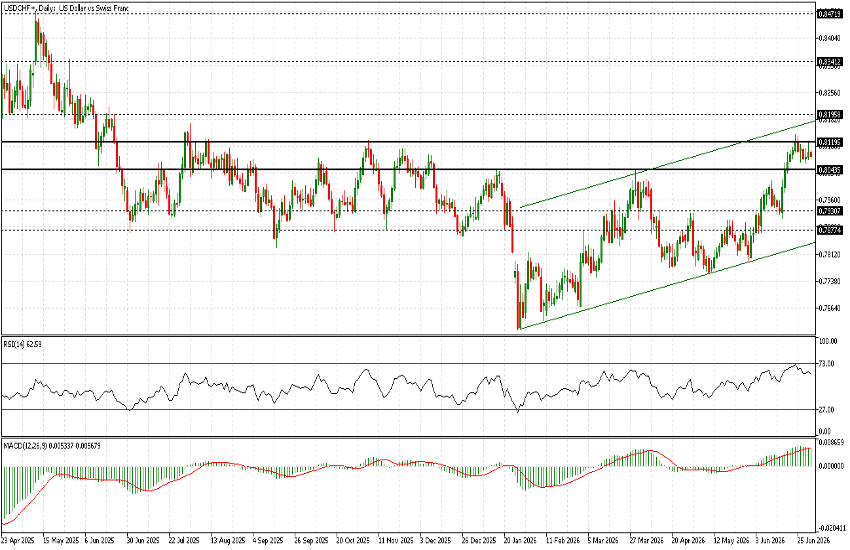
The 0.8180–0.8200 region represents a significant technical hurdle, combining the upper boundary of the ascending channel with a resistance zone that has capped rallies on several occasions throughout 2025. This area will likely determine whether the current recovery can extend further.
Technical indicators remain constructive and are still well below overbought territory, suggesting there may be scope for additional upside if resistance is cleared.
A sustained break above the current resistance zone would shift attention toward the next key levels at 0.8340 and 0.8470, although that scenario remains secondary for now.
On the downside, initial support is located at 0.7930, followed by the more important 0.7875 level. A move below these areas would weaken the near-term bullish structure, although this is not currently the base case.
Overall, USDCHF remains close to a major resistance zone, but the broader technical picture continues to support a cautiously constructive outlook while the pair holds above nearby support levels.