


On the day the ECB is expected to raise its benchmark interest rates in Europe (by the way, keep an eye on the time window between 14:15 and 14:45 CET, when the decision will be announced and then discussed during the usual press conference by Christine Lagarde—all while the U.S. PPI release is also due), let’s take a look at the benchmark among European equity indices: Germany’s DAX.
The index has been stuck in a prolonged sideways phase for more than a year, roughly contained during the majority of the time between 22,800 and 25,000, a range of about 10%. It has been a dream environment of relatively low volatility and consistent technical reference levels for swing traders skilled at navigating directionless markets.
The index is highly diversified and provides a solid representation of the complexity of Germany’s industrial economy. Among its top ten constituents are automotive giants such as Mercedes-Benz Group, banking heavyweights such as Deutsche Bank, defense contractor Rheinmetall, insurance leader Allianz, and industrial conglomerate Siemens.
What may be missing, among so many well-known names recognized even beyond the investment community, is a company that fully captures the current AI and semiconductor hype. The largest company by market capitalization, at roughly €275 billion, is SAP SE, which operates in the technology and software sector and is arguably the clearest AI play within the index. SAP is supplying the SAP Business Technology Platform as the enterprise software layer of Germany’s Industrial AI Cloud, the sovereign AI initiative known as the “Deutschland-Stack.” The company has also been aggressively embedding generative AI capabilities (“Joule”) across its ERP and cloud software suite.
However, the stock has not been performing well and is, somewhat surprisingly, still down 45% from the highs reached in May 2025.
By contrast, Infineon Technologies has been one of the standout performers. The company designs and manufactures power semiconductors—chips that control, convert, and manage electrical energy rather than process data. Its main end markets include automotive electronics, industrial systems, AI data-center power infrastructure, and connected and security devices. The stock is up 91% year-to-date, making it the strongest performer in the DAX this year, and it currently boasts a market capitalization just below €100 billion.
Overall, this diverse landscape—and the wide dispersion in individual stock performance—has somewhat capped the DAX’s upside potential. Strong gains from Rheinmetall, as well as from Commerzbank and Deutsche Bank, have been offset by SAP’s struggles, leaving the German benchmark index with a year-to-date performance of -1.20% as of yesterday’s close.
Technical Analysis
Let’s focus on the 1-hour chart and the latest leg within the long-term sideways range discussed earlier. This leg is clearly pointing lower after the index reached the previous highs around 25,450, marking the third test of that area. Prices had already been sharply rejected from this zone twice before, around the turn of 2025 and 2026.
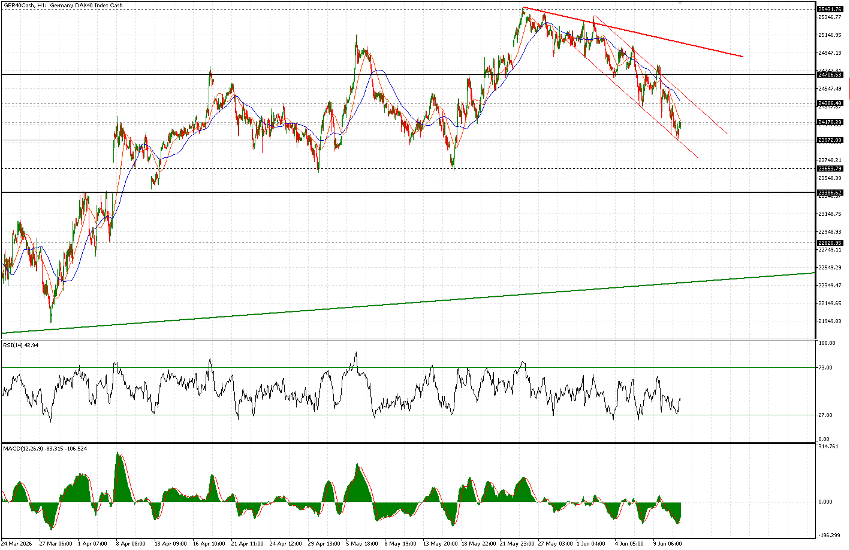
The most natural direction therefore appears to be toward the 23,400 area and potentially even lower, into the 22,820–23,000 region. Should prices reach that zone in the coming days, it would represent a very important test, as it also coincides with the long-term trendline that has been in place since August 2022.
The move began on May 27 with the market’s inability to break above the previous high and then accelerated after June 2, when further attempts to grind higher also failed. Price action is now clearly contained within a descending channel, whose lower boundary has just been tested.
This, combined with the fact that the test occurred around the psychologically significant 24,000 level—which also acts as support—suggests that downside momentum could temporarily slow from here.
At the same time, we believe the upside potential remains capped. The current price area around 24,170 already represents a first resistance level, followed by a more significant hurdle near 24,385. We do not currently see a clear path for a sustained move above this second level.
In fact, we would not be surprised to see the GER40 continue lower over the coming days, initially targeting 23,650 and potentially extending the decline toward 23,385. Beyond that, the outlook becomes more of a longer-term story, one that will depend on how the market reacts once those key support areas come into play.