



Yesterday marked a highly volatile session for oil futures, with prices swinging sharply throughout the day before closing near their opening levels. WTI recorded a $6.60 intraday range between its high and low, ultimately finishing just $0.10 above its open and forming a Doji in candlestick terms. Brent followed a very similar pattern.
This price action unfolded amid a steady flow of news and market speculation. A report from Al Arabiya suggesting Iran’s willingness to accept a long truce and a long-term nuclear freeze initially pushed futures lower. Shortly after, Axios reported that a senior US official viewed the proposal as insufficient, triggering a rebound in prices. Later, Donald Trump stated that he had prevented an imminent military attack, adding further uncertainty.
As noted in a previous discussion, oil futures are inherently volatile, and current geopolitical developments are amplifying that behaviour. One strategy previously highlighted was trading the spread between WTI and Brent to help mitigate directional risk. This approach is grounded in the statistical cointegration of the two benchmarks, meaning their price spread tends to remain relatively stable over time and can be modelled using parameters such as mean and standard deviation.
Historical analysis identified relatively consistent maximum and minimum levels for the spread, offering useful reference points for trading decisions. While current conditions have pushed the spread beyond typical historical ranges, the underlying logic of spread trading remains intact.
Technical Analysis
All data used in this analysis was sourced from the MT5 platform. A detailed guide on extracting this data will be provided in a future educational post.
Using a historical dataset starting from January 2025, the spread showed a maximum Brent premium of $6.21 and a minimum of $1.06, with an average level of $3.60. Although this is not immediately obvious from a limited timeframe, extending the analysis further back confirms that these levels have historically defined the spread’s normal range.
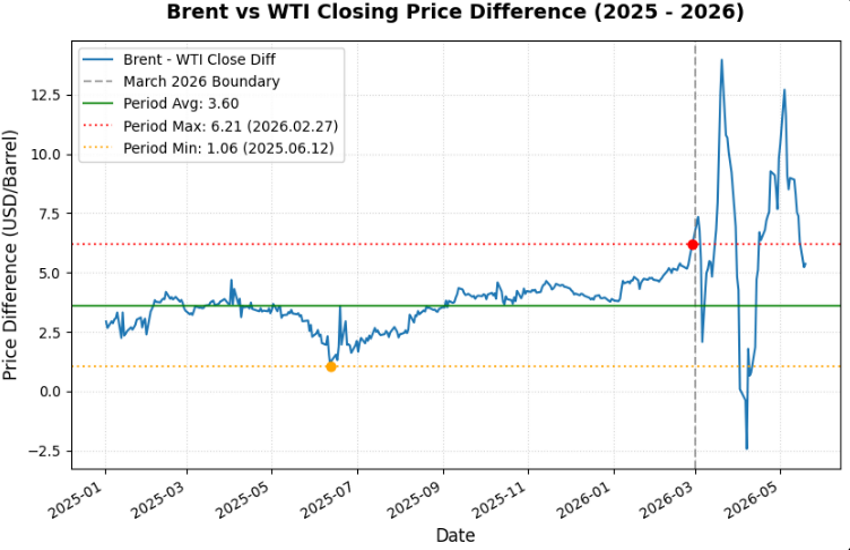
From a trading perspective, when the spread approached $1, it presented opportunities to buy Brent and sell WTI, anticipating a widening back toward the mean. Conversely, near the $6 level, buying WTI and selling Brent could position for spread compression. This relative value approach reduces outright exposure to directional price movements.
The current market environment, however, represents an extreme deviation. Over the past two months, the spread has expanded well beyond historical norms, underscoring the exceptional conditions in energy markets. Despite this, the core framework of the strategy remains relevant, while also highlighting the importance of risk awareness.
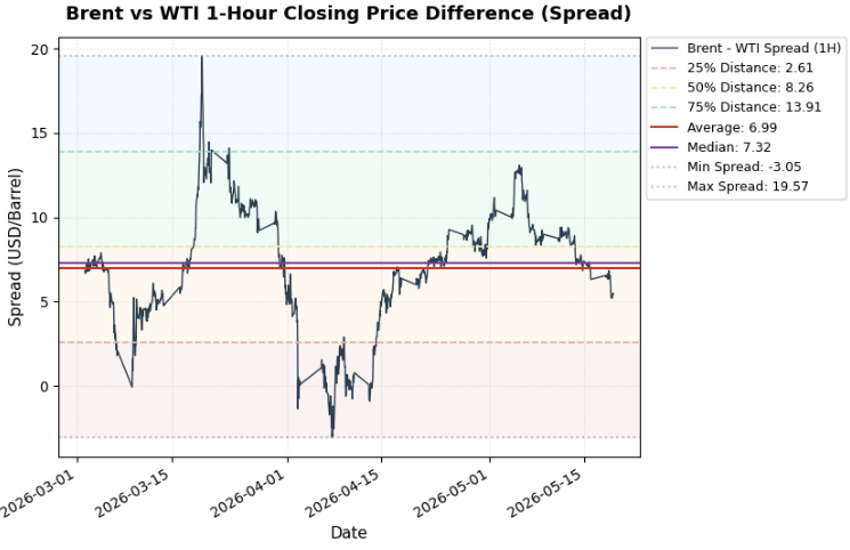
A closer look at the 1-hour spread evolution shows a peak of $19.57 and even a negative low of $3.05, both highly unusual outcomes. The average spread during this period has been approximately $7. Comparing this with the long-term average of $3.60 suggests the potential for gradual normalisation, implying further compression from recent levels, with the spread recently around $5.46.
In practical terms, this scenario would favour long WTI and short Brent positions. Notably, the spread has already declined from levels near $13, indicating that some normalisation may already be underway.
Market participants should draw their own conclusions based on their investment horizon and risk tolerance. This analysis is intended to illustrate a methodology rather than provide specific trading recommendations.
Finally, it is important to account for contract specifications. Futures contracts have different expiration dates for Brent and WTI, which can impact spread positions. Financing costs, including swaps, should also be carefully considered when managing trades.