



The Australian dollar led currency moves, falling 0.52% against the US dollar to 0.7115 following a significantly weaker-than-expected labour market report. April data showed a loss of 18.6K jobs, sharply missing expectations for a 17.5K increase. The unemployment rate rose to 4.5% from 4.3%, marking its highest level since November 2021, while labour force participation declined to 66.7%. Overall, the release points to a notable deterioration in labour market conditions.
Australia’s macroeconomic backdrop had been strong. Annualised GDP most recently printed at 2.6%, while inflation accelerated to 4.6% year-on-year in March, reinforcing the view of a hot economy with persistent demand pressures. In response, the Reserve Bank of Australia implemented an aggressive tightening cycle, lifting the policy rate from 3.6% to 4.35% through three consecutive hikes.
However, elevated living costs have weighed on consumer sentiment, and services PMI data has begun to indicate contraction. Despite these headwinds, the Australian dollar had remained supported by resilient commodity prices prior to the latest data release.
The labour market shock triggered a sharp intraday decline in AUDUSD. More broadly, commodity-linked currencies have faced pressure against the US dollar, with the Canadian dollar also underperforming through May.
Technical Analysis
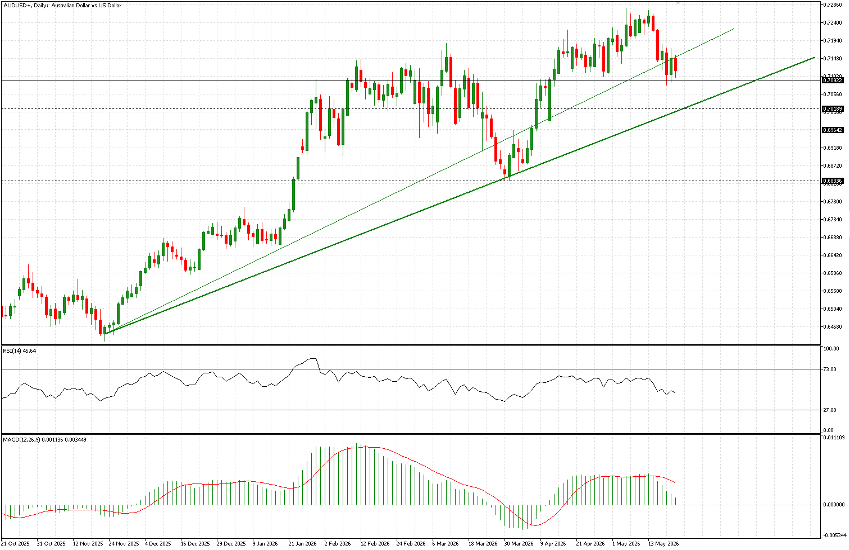
On the daily timeframe, a bullish trend has been in place since November 2025, originating near the 0.6440 level. Two trendlines can be identified. The first, which previously provided support in January and March, now appears to have been broken. The second trendline, connecting the November lows with early April 2026, currently intersects near 0.7020 and continues to act as a key support zone.
Additional support levels are located at 0.7090 and 0.6965. Momentum indicators are weakening, with the RSI below 50 at 45.54 and the MACD trending lower.
On the 30-minute timeframe, a short-term downtrend has been in place since May 13, initiated from highs at 0.7270. Price action has consistently failed to reclaim these levels, with recent rallies facing rejection. A brief recovery followed a test of 0.7090, forming a short-term double bottom with slightly higher lows, but the move lacked follow-through.
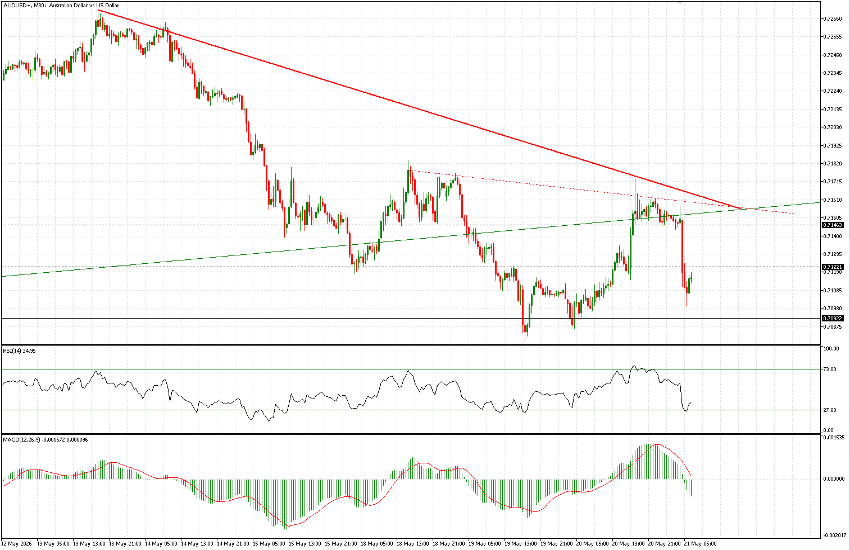
Following the labour data release, AUDUSD retested support near 0.7098 and is attempting a modest rebound. Immediate resistance is seen at 0.7122, followed by 0.7145. A break above this zone would bring the descending trendline back into focus.