



EURAUD continues to reflect the growing divergence between the eurozone and Australian macroeconomic outlooks, as monetary policy, energy exposure, and commodity dynamics increasingly shape relative currency performance. While the eurozone faces weaker growth and persistent energy sensitivity, Australia continues to benefit from resilient domestic activity and strong commodity-linked support.
The eurozone remains a large, diversified, service-driven bloc that is heavily reliant on energy imports, leaving it exposed to commodity shocks. Australia, by contrast, is a resource-exporting economy that benefits directly from elevated prices in energy, iron ore, and liquefied natural gas.
This divergence has become more pronounced in 2026. Australia’s economy expanded by 2.6% year-on-year in the fourth quarter, marking its fastest pace in two years. Meanwhile, the ECB’s March projections lowered eurozone GDP growth to 0.9% for 2026, highlighting the drag from rising energy costs on consumer purchasing power and sentiment.
Geopolitical tensions in the Middle East have further reinforced this imbalance. Elevated energy prices support Australia’s terms of trade while compressing European corporate margins and household income. The macro backdrop therefore continues to favour the Australian dollar over the euro.
Monetary policy remains the clearest driver of the downside trend in EURAUD. The Reserve Bank of Australia raised its policy rate to 4.35% in its third consecutive hike this year, with a strong majority backing the move. Headline inflation is expected to peak at 4.8% in mid-2026, while core inflation is projected to remain above 3% until mid-2027.
In contrast, the ECB has kept rates unchanged while facing a stagflationary backdrop. Inflation expectations have been revised higher to 2.7% for 2026, while growth forecasts remain subdued at around 1.0%. This continues to limit the central bank’s policy flexibility.
The yield differential between Australian and European bonds has widened to approximately 130 basis points. Combined with stronger growth momentum and commodity support, this continues to exert downward pressure on EURAUD. Unless eurozone energy conditions improve materially or the RBA shifts its stance, the bias remains tilted to the downside.
Technical Analysis
EURAUD is approaching a critical support zone between 1.6150 and 1.6000. This area has historically provided strong support, with price action holding above this range for most of 2023 and 2024.
Below this zone, the next key level is near 1.5300, with intermediate support located around 1.5860.
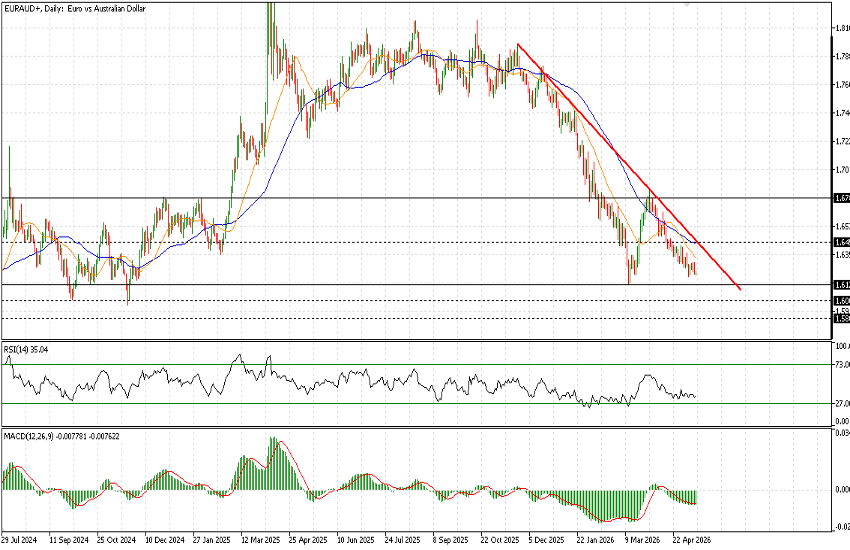
EURAUD Daily Jul 2025 to Present
After establishing a low at 1.6127 on March 11, the pair rebounded toward resistance at 1.6800 before resuming its decline. The 1.6450 level remains an important secondary reference point.
Technical indicators continue to point lower. Moving averages are trending downward and have crossed bearishly, with the shorter-period average positioned below the longer-term average.
Another test of the 1.6150 area appears likely, with the pair currently trading near 1.6219. Market reaction around this level will be critical in determining near-term direction. A potential double bottom could attract buying interest, triggering a corrective move toward the 21-day moving average at 1.6325 and the 50-day moving average at 1.6420. The latter also aligns closely with a descending trendline in place since November.
However, both the macroeconomic backdrop and the broader technical structure continue to favour downside risks. A break below support could open the path toward the psychological 1.6000 level, with a possible extension toward 1.5860. Further price action will determine whether a deeper move toward 1.5300 becomes increasingly viable.