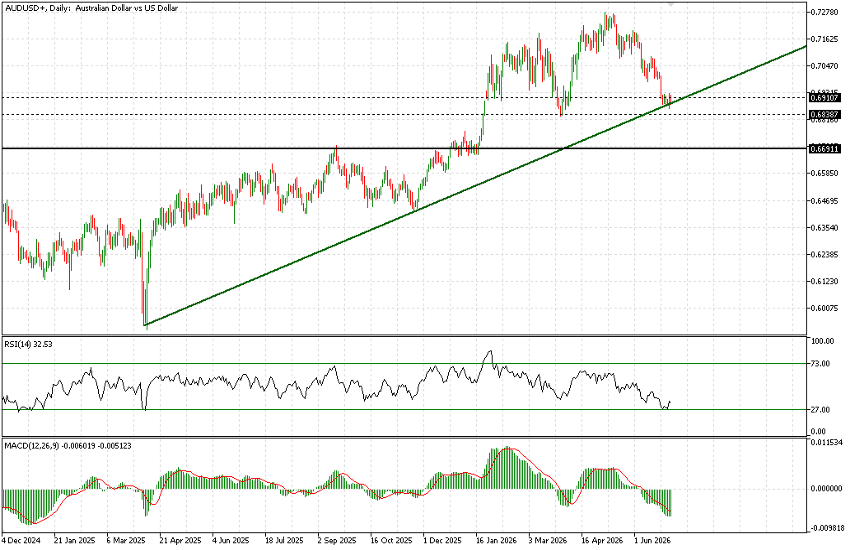



AUDUSD has extended its decline to fresh three-month lows near 0.6870 and is now down more than 4% for the month, even after the Reserve Bank of Australia held its cash rate steady at 4.35% in June.
The weakness in AUDUSD is not primarily an RBA story. The central bank’s June meeting minutes maintained a hawkish tone, highlighting persistent underlying inflation and a willingness to tighten policy further if necessary. Domestic conditions also remain relatively resilient, supported by steady consumption and business investment. Instead, the Australian dollar has come under pressure as markets increasingly price a more hawkish Federal Reserve, strengthening the US dollar.
The Australian dollar is also one of the market’s most risk-sensitive currencies. As a high-beta, commodity-linked currency, it typically weakens when global risk sentiment deteriorates. June’s sharp semiconductor selloff, which erased more than $1.3 trillion in market value across major AI-related companies, triggered a broad risk-off move that weighed on equities and currencies alike.
China remains another key driver. As Australia’s largest trading partner and the biggest buyer of its commodity exports, stronger Chinese demand generally supports the Australian dollar. However, although China’s latest Manufacturing PMI improved to 50.3, the data were not strong enough to signal a convincing recovery in economic activity. Combined with ongoing trade uncertainty, this has left AUD without meaningful support from the region.
Technical Analysis
Two of AUD’s core drivers—global risk appetite and China-linked commodity demand—are currently providing only modest support. This helps explain why a relatively hawkish RBA and resilient domestic data have so far provided only limited support for the Australian dollar.
Looking ahead, AUDUSD will remain sensitive to the direction of the US dollar, Federal Reserve policy expectations, global risk sentiment, and incoming economic data from China. Together, these factors are likely to determine the pair’s next directional move.