



Japan’s monetary trajectory in 2026 is arguably the most consequential among G7 economies. After decades of deflation, the country is now experiencing a demand-driven inflation cycle supported by sustained wage growth, prompting a gradual but clear response from the Bank of Japan.
The BoJ has reaffirmed that a cycle of moderate wage and price increases is likely to persist, with the probability of sustainably reaching its 2 percent inflation target continuing to rise. The spring Shunto wage negotiations have delivered meaningful pay increases for the third consecutive year, providing a fundamental basis for further policy tightening.
At its April meeting, the BoJ kept rates unchanged at 0.75 percent but revised its core inflation forecast upward to 2.8 percent. At the same time, it lowered its FY2026 growth projection to 0.5 percent, reflecting pressure from elevated oil prices on corporate margins and household real incomes. This introduces a mild stagflationary dynamic, complicating the timing of future rate hikes.
The Japanese government bond curve reinforces this shift. Expectations of additional tightening, combined with fiscal concerns under Prime Minister Takaichi’s expansionary stance, have pushed the 10 year JGB yield above 2.5 percent for the first time since 1997. The long end of the curve continues to steepen amid rising concerns around debt sustainability.
The eurozone entered 2026 on a disinflationary path. Headline inflation fell to 1.7 percent in January, supported by moderating wage growth, while the European Central Bank concluded a rate cutting cycle that brought the deposit rate to approximately 2.15 percent.
This trajectory shifted following renewed geopolitical tensions in the Middle East. By April, inflation had accelerated to 3 percent, its highest level since September 2023, driven largely by a 10.9 percent increase in energy prices. Inflationary pressure has broadened across major economies including Germany, France, Spain, and Italy.
Despite this, wage dynamics remain contained. The ECB wage tracker indicates negotiated wage growth of 2.6 percent in 2026, down from 3.0 percent in 2025 and well below post-pandemic highs. While short term inflation expectations have risen sharply, longer term expectations remain anchored near 2 percent. This explains the ECB’s decision to hold rates steady rather than resume tightening.
If the BoJ proceeds with additional rate hikes in the second half of the year and moves toward 1 percent, with a longer term path toward its estimated neutral rate of 1.5 percent, the interest rate differential with the eurozone will narrow.
As a result, the carry trade that has supported EURJPY is likely to unwind gradually, creating downward pressure on the pair.
Technical Analysis
Market participants are increasingly signalling intolerance toward further yen weakness. Levels above 160 against the US dollar are under close scrutiny and have already triggered multiple interventions, including a notable episode two weeks ago. Given the euro’s relative strength against the dollar in recent years, this corresponds roughly to the 186 to 187 range on EURJPY.
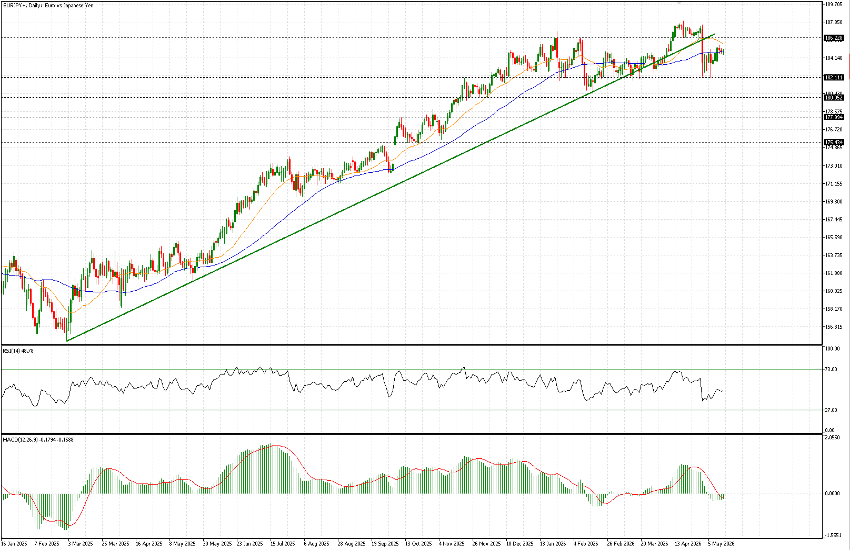
EURJPY, Daily, FEB 2025 – Now
Interventions on April 30 and the more moderate action on May 5 are clearly reflected in two large bearish candles on the daily chart. Even in the absence of intervention, price action has repeatedly rejected the 186.50 level, with sharp retracements toward 182 on January 23 and 180.75 on February 9.
These levels remain critical. More importantly, the uptrend that began in February 2025 appears to have broken. This suggests a deceleration in upward momentum. While this does not necessarily indicate an immediate reversal, it often precedes a consolidation phase that can eventually resolve to the downside.
Price is currently testing the 50 day moving average and trading below the 21 day moving average, while the MACD has turned negative. Although long yen positions remain unattractive from a carry perspective, the broader macro and technical backdrop suggests that this consideration may become less relevant.
The Japanese yen may be approaching a phase not seen since 2017, characterised by stabilisation and potentially renewed strength.