




EUR/USD is holding steady around 1.1625 on Tuesday, September 8, with traders remaining cautious ahead of two major market catalysts this week: the European Central Bank (ECB) interest rate decision and the latest US inflation data. The pair has remained above the key 1.1600 level as investors assess the diverging monetary policy outlooks between Europe and the United States.
Recent US employment data has strengthened expectations for a more hawkish Federal Reserve. The US economy added 162,000 jobs in August, significantly above the market forecast, while unemployment remained at 4.1%. As a result, expectations for a September Fed rate hike have risen to around 60%.
The next major test for the US dollar will come from the Producer Price Index (PPI) and Consumer Price Index (CPI). Hotter-than-expected inflation could reinforce expectations for higher US interest rates, potentially supporting the dollar and putting downward pressure on EUR/USD. Conversely, softer inflation could weaken the dollar and give the euro more room to recover.
In Europe, attention is turning to the ECB, with markets widely expecting a 25-basis-point rate increase, which would take the deposit rate to 2.50%. Investors will also closely examine the ECB’s guidance on future policy. A more hawkish message could strengthen the euro, particularly if policymakers signal that additional tightening remains possible.
Technical Analysis
On the daily chart, EUR/USD remains cautiously bullish after breaking above the long-term descending trendline. The pair is trading near 1.1629, with 1.1613 acting as the key short-term support. Holding above this level would keep the bullish structure intact and indicate that buyers are still defending the breakout.
However, momentum has started to soften. The RSI is around 57, remaining above the neutral 50 level but still far from overbought territory. At the same time, the MACD has weakened, with the MACD line below its signal line and the histogram slightly negative, pointing to fading upside momentum and a possible period of consolidation or correction.
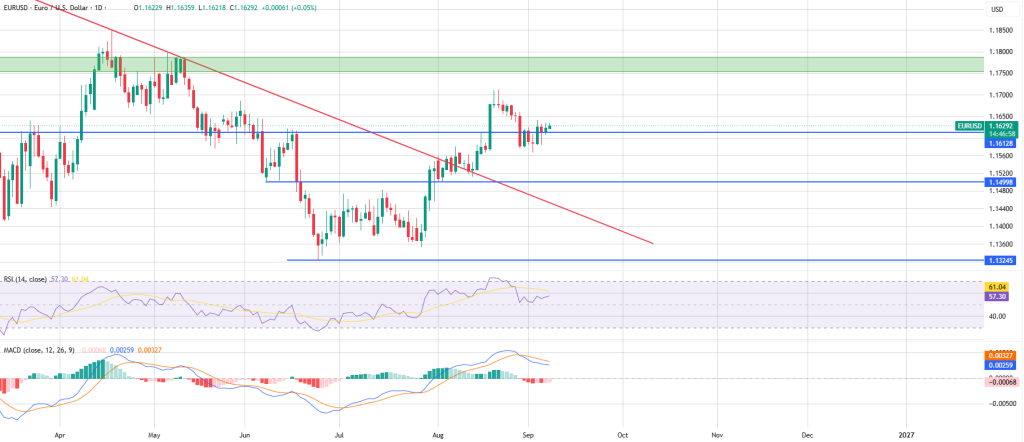
On the upside, 1.1700 is the first resistance to watch. A sustained break above this level could strengthen the bullish outlook and open the way toward the 1.1750–1.1780 zone, where previous price congestion could attract sellers.
On the downside, 1.1613 remains the immediate support. A daily close below this level could signal a deeper correction toward 1.1500, while a stronger sell-off could bring 1.1325 into focus. Until then, the bias remains bullish as long as EUR/USD holds above 1.1613.
This setup is especially important for traders because upcoming US inflation data and the ECB rate decision could trigger significant volatility. Hotter US inflation may strengthen the dollar and pressure EUR/USD lower, while softer inflation combined with a hawkish ECB could support a move above 1.1700.