



On the night of Tuesday, February 24, 2026, the People’s Bank of China (PBoC) held its policy meeting. Although this event is typically less monitored by retail brokers, it remains highly relevant for macro positioning. The central bank left the one-year Loan Prime Rate (LPR) unchanged at 3.00%—its primary policy benchmark—and maintained the five-year LPR at 3.50%, marking the ninth consecutive month without adjustment. The decision was fully in line with market expectations.
Two key factors were cited as reducing the urgency for additional rate cuts. First, Chinese banks are operating under compressed net interest margins; further rate reductions would materially impair banking sector profitability. Second, export performance remains robust, limiting the need for immediate monetary stimulus. In essence, while domestic conditions are uneven, the external sector continues to provide sufficient support to overall growth.
As of today, USDCNH is trading at 6.8358, representing a 33-month low. The yuan has accelerated its pace of appreciation in recent sessions. This development is significant for several reasons. Over the past fifteen years, Chinese authorities have actively managed the exchange rate, often allowing depreciation of the renminbi during periods of economic slowdown to support competitiveness. Since 2022, the 7.20–7.35 range in USDCNH had become a critical upside threshold, reflecting structural stress within the Chinese economy.
Indeed, despite areas of resilience, China continues to face material headwinds: a multi-year correction in the property sector, subdued domestic consumption, adverse demographic dynamics, and persistent deflationary pressures. However, the primary driver of the yuan’s current strength remains the export sector. In early 2025, China’s trade surplus expanded significantly, reaching USD 125.4 billion in the first quarter alone. Surpluses of this magnitude generate structural foreign currency inflows, as exporters receive U.S. dollars and convert them into yuan, creating sustained demand for CNH.
China never fully transitioned to a domestic consumption-led growth model following the 2008 global financial crisis and remains fundamentally export-oriented. Importantly, a stronger yuan is now less detrimental to export competitiveness than in the past, as China has moved decisively up the value chain. In sectors such as electric vehicles, solar panels, batteries, industrial machinery, and advanced electronics, the country increasingly competes on technology, scale, and supply chain integration rather than solely on price.
Another structural factor contributing to the downward movement in USDCNH is China’s strategic reallocation of foreign reserves away from U.S. Treasuries. Over the past several years, the country has been a net seller of U.S. government securities by approximately USD 50 billion per year, reflecting a broader diversification strategy.
It is important to clarify that USDCNH (the offshore yuan traded by international investors) is not a fully free-floating currency pair. The PBoC sets a daily midpoint fixing for the onshore yuan (CNY), which acts as a policy anchor and strong signaling mechanism for both onshore and offshore markets. This framework reflects a managed exchange rate regime designed to provide international currency exposure while allowing the Chinese authorities to retain substantial control over valuation dynamics.
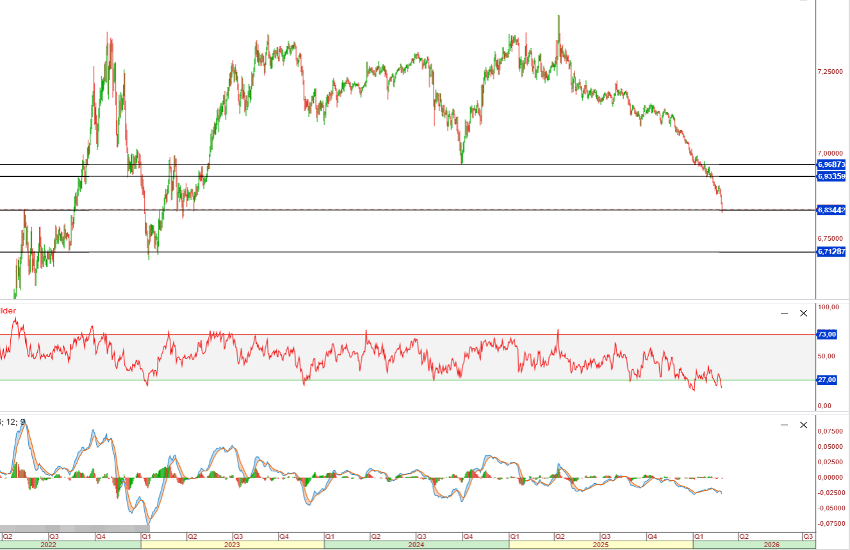
In short, even if you choose not to trade this currency pair—typically not among the most volatile—monitoring it can still provide valuable insight. It serves not only as an indicator of the underlying health of the Chinese economy, but also—more importantly for international investors and traders—as a gauge of the strength and quality of global demand, a variable that should consistently remain on our radar.