



There is a second major shift—the first is obviously the oil shock—produced by the current crisis in the Middle East: the policy outlook of the major global central banks has changed rapidly, and this is something we will discuss in greater depth later this week. The discussion is no longer only about accommodative policy and rate cuts; it has begun to include pauses or even hikes.
The money market now expects the Fed to remain on hold at least until September (only a few days ago, a first US rate cut was expected in June). For the UK, the probability of a rate hike this year has risen above the threshold of randomness (54%), while regarding the ECB, a rate increase by July is now fully priced in by ESTR futures, with a second hike by December carrying a high probability (85%). The shock in expected prices is beginning to cast its long shadows and, for the euro—at least in terms of strength—this could be a positive sign.
This morning we focus on EURAUD, which in 2026 has been literally collapsing, with the Aussie up +7.41% as of yesterday’s settlement.
The Australian economy, moreover, is performing quite well; it is even being described as overheated. Inflationary pressures picked up materially in the second half of 2025, with private demand growing more quickly than expected, capacity pressures greater than previously assessed, and labour market conditions somewhat tight. GDP growth is forecast to reach 2.4% in early 2026, and the RBA decided to increase the cash rate target by 25 basis points to 3.85% at its February 2026 meeting, placing it somewhat “ahead” of what now appears to be the potential path the ECB could also follow.
TECHNICAL ANALYSIS
The inflection point for the cross occurred in December 2025—two months before the RBA move—when EURAUD first lost the key support at 1.7585 and then, after attempting a rebound and to reclaim that level, also broke below the red line at 1.7462. Since then—with the retest of the aforementioned level occurring on January 20—the euro has depreciated rapidly against the AUD, ignoring several interesting supports such as 1.72, pausing for only a handful of sessions around 1.6770, and then continuing down to a low of roughly 1.6150 last week.
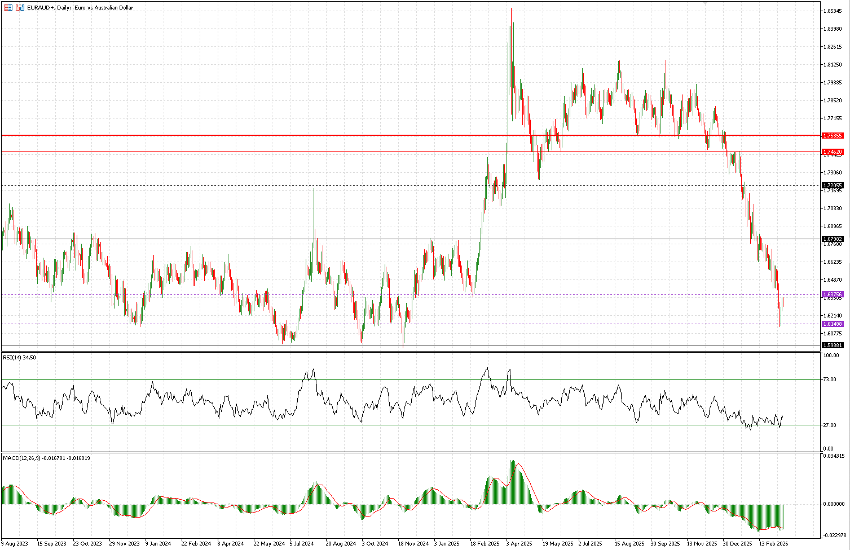
The area where the cross currently trades is quite congested on a longer-term basis. EURAUD traded between 1.5990 and 1.6770 from March 2023 until February 2025. Within this range, the most relevant levels for swings are 1.6150 and 1.6375.
The current price of 1.6294 is therefore very close to the key support at 1.5990, and the last two sessions have printed strong green candles. The RSI is low at 34.5 and touched oversold territory at the end of January, now showing a slight divergence.
The MACD histogram has not yet crossed to the upside but appears close to doing so.
We believe this represents a good medium-term buying opportunity, while paying attention to swaps. Consolidation in this area is expected, potentially including a new test or marginal break of recent lows.
However, we consider 1.60 to be a good level to initiate long positions on the cross. From a medium- to long-term perspective, the stop loss will not be particularly tight and is placed around 1.585, with position sizing adjusted accordingly, also keeping firmly in mind that the trend remains bearish for now and has not yet reversed.