



The company that has reshaped multiple industries and the daily lives of billions of people requires little introduction. Over the past decades, the iPod, iPhone, and iPad have fundamentally redefined how music is consumed, how and where information is accessed, and how users navigate the internet. However, for several years now—arguably since the passing of Steve Jobs—the company has not delivered a product with the same disruptive, game-changing impact as its earlier innovations. Moreover, it has rarely featured at the center of discussions around artificial intelligence. By way of example, the company has entered into a partnership with its rival Google to power Siri using the Gemini large language model.
That said, the company’s underlying corporate health and financial position remain exceptionally strong. The most recent results report total revenue of $102.5 billion (+8% year-on-year), net profit of $27.5 billion, and a gross margin of 47%. Management guidance also points to continued growth in the range of 10–12%. In addition, the Cupertino-based company holds $132 billion in cash and marketable securities (against $99 billion in debt), providing substantial financial flexibility across multiple fronts—from R&D spending (expected to reach approximately $18 billion next year) to potential share buyback programs.
Despite these strengths, markets have stopped rewarding the stock over the past months.
TECHNICAL ANALYSIS
The reason we have selected Apple today is to highlight a setup that differs from those we have commonly observed in recent weeks, during which many securities have been trading at or near all-time highs and continuing to push higher. AAPL recorded an intraday peak on December 3 at $288.34 and has since entered a corrective phase with notable momentum to the downside. In fact, in the coming days we may observe that several Big Tech names have been “losing steam” over recent weeks. At yesterday’s close, at $246.70 (-3.46%), total losses since that peak amount to 14.52%.
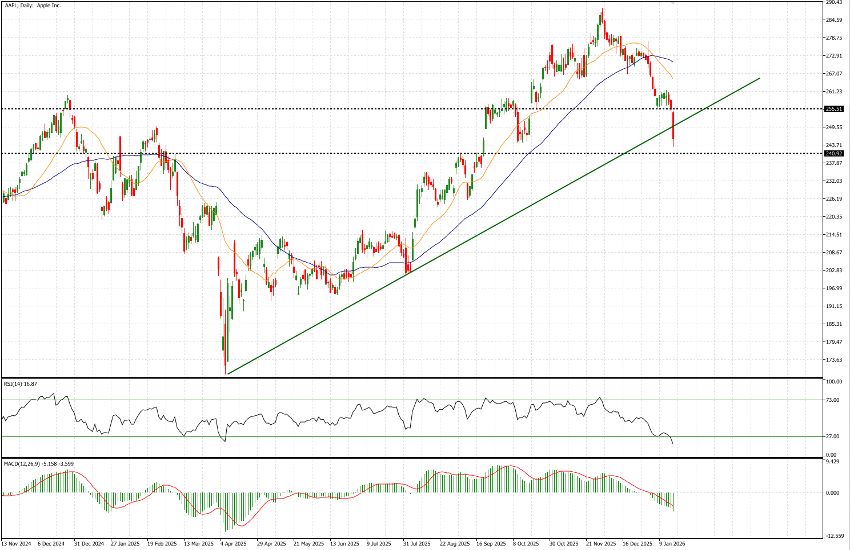
What is particularly noteworthy is that the stock has just tested and decisively broken its long-term upward trendline. If confirmed, this would represent a materially negative technical signal. The emphasis on confirmation is critical: a single close is not sufficient to state with certainty that a structural break has occurred, and today’s session will therefore be pivotal. Should the stock manage to close above $250, the bearish signal would be invalidated, and the move would be classified as a textbook false breakdown.
Technical indicators—by definition derived from price action—are broadly negative. The 21-day and 50-day moving averages have crossed to the downside, while both the MACD and RSI are weak. Although the RSI is currently in oversold territory, this should not be interpreted as a bullish signal; on the contrary, it reflects underlying price weakness.
On the upside, the key level has already been identified, with an additional critical resistance located at $255.5. On the downside, attention should be paid to yesterday’s lows at $243.40, followed by the $ 241 area, which must hold. A break below this level would constitute another clearly negative signal.