

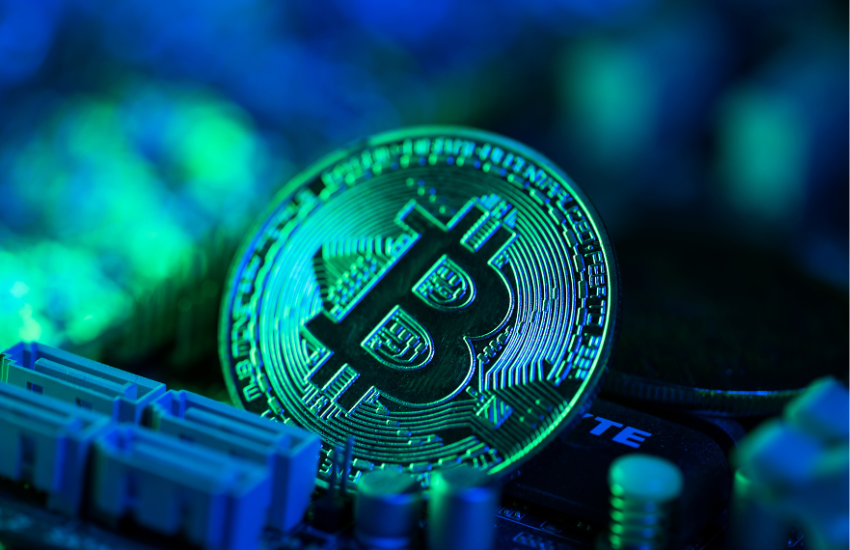
Bitcoin was invented by Satoshi Nakamoto in 2009 along with the software that supports it. To this day, it remains a mystery whether the mind behind the name is an individual or an institution. Bitcoins are created through a process known as bitcoin mining, which we will explain in detail below.
Origin and History of Bitcoin
The origin of Bitcoin as a cryptocurrency dates back to 2009. History indicates that its creator had the pseudonym Satoshi Nakamoto.
Although the domain bitcoin.org was indeed registered in 2008, in October of that year, Satoshi Nakamoto wrote an article called «Bitcoin: A peer-to-peer electronic cash system».
In that document, he mentioned how the network works, how bitcoins were generated, and what its advantages were. After that, in 2009, the origin of the first open-source Bitcoin client was born and the network started to become progressively more popular.
What Is Bitcoin and How Does It Work?
Although Bitcoin does not exist in physical form, it has the same functions as fiat money. Unlike common currencies, bitcoins do not have serial numbers or any other mechanism that allows tracking of buyers and sellers who use this virtual currency. This feature makes it attractive for those seeking privacy in their transactions.
Unlike any type of currency, Bitcoin is not fiat money. This means that it is not backed by a central entity such as a bank, a government, or by a material, such as the gold standard. Instead, Bitcoin uses a proof-of-work system to avoid double spending and to achieve a consensus among all the nodes operating in the network.
Blockchain
The blockchain is a fundamental part of Bitcoin’s optimal functioning because falsifying a transaction would require changing records on many computers. As a public record, there could be millions of copies, and altering the records on all these computers would be practically impossible.
Additionally, bitcoin transactions handle an open code for its operation and do not need an intermediary to execute the transactions. Therefore, it promises to have lower transaction costs.
It is important to remember that while most other currencies exist in physical form, only 8% of the money in the world is physical; the rest is electronic money according to bank balances.
Characteristics of Bitcoin
To avoid inconveniences related to a currency that is not backed by an entity or a third party but by a working system, BTC has several unique principles:
- Limited to 21 million: The volume of units can never exceed 21 million bitcoins. Consequently, the money supply is limited, unlike fiat currencies, where the central bank can issue as much currency as it wishes.
- Uncensored: It is not possible to prohibit or censor transactions that have been previously validated.
- Open source: The source code used must be accessible to everyone.
- Accessible to everyone: Everyone can make transactions in bitcoins without having to ask for permission. No one person can prohibit participation in the network.
- It uses pseudonyms: The true identity of its owner is not revealed, and it is not necessary to identify oneself to participate in the Bitcoin network. However, unlike an anonymous network, it allows the possibility of generating reputation and trustworthiness among different users.
- It is interchangeable: The units can be exchanged.
- Its payments are irreversible: transactions that have been confirmed cannot be modified or deleted.
How are Bitcoins Generated?
Bitcoin is a cryptocurrency that is generated and distributed through peer-to-peer networks, usually known as P2P (peer-to-peer). This type of network enables the direct exchange of information without the existence of fixed servers. The mechanism for creating BTC is cryptocurrency mining. This system consists of solving highly difficult mathematical problems using computer processors.
The person who solves a problem receives a reward in BTC. It is an incentive that makes more people join this process. Each participant connects through the P2P system and validates each movement in the system. Therefore, the more participants there are, the more secure the process will be. As problems are solved, the difficulty of the problems increases. In this way, the speed of BTC generation is controlled.
Bitcoin is not regulated by anyone. However, it is structured so that the generation speed is reduced by 50% every 4 years until reaching 21 million BTC in circulation.
Over time we are approaching the 21 million limit. If the demand for bitcoins continues to increase and the supply remains limited, the price of Bitcoin will likely rise. That is, as long as demand is maintained.
How to Use Bitcoins
It is time to see how we can manage these digital currencies. Bitcoin is money, it has certain characteristics that distinguish it from other currencies. However, being the currency that it is, it meets the properties of money:
- It functions as a unit of account
- Exchange mechanism
- Serves as a store of value
The latter is the one that is generating the most controversy around Bitcoin because of its volatility.
Regarding its usefulness as a unit of account, little or nothing more needs to be added. The same is not true of its exchange qualities. The introduction of Bitcoin meant a rupture in electronic commerce as it was known until then.
That is to say, it breaks with the corresponding service fees to which transactions were subordinated.
Conclusion
Bitcoin may represent a unique investment opportunity. Since Bitcoin’s entry into the market, it has always led the cryptocurrency market. Today more and more people are using bitcoin or other cryptocurrencies in their daily lives. As discussed in this article, cryptocurrencies do not need a third party to operate and can be used anonymously. Likewise, it is very difficult to hack due to the technology it uses.
If you are thinking about an investment method, it is advisable to carry out a prior study to see if it fits your trading plan or your investment style. It should not be forgotten that cryptocurrencies can sometimes suffer from volatility; therefore, it is important to have good asset management and never invest more than you can afford to lose.